


If, as the old joke goes, legislating is like making sausage, pigs can apparently rest easier. The number of laws passed and signed into law during the 112th Congress in its first 15 months has put it on track for a potentially historic low.
According to an analysis by BNA, the 112th Congress is on track to eclipse the 1995-1996 104th Congress in terms of the fewest number of laws enacted. With the signing of the Jumpstart Our Business Startups (JOBS) bill easing restrictions on start-up companies (
By comparison, the 111th Congress, when Democrats held both the House and the Senate as well as the White House, saw a total of 383 laws enacted. The 1995-1996 Congress, which swept in Republican majorities in the House and Senate, finished with 333 laws enacted, the lowest number since at least the 77th Congress, which spanned from 1941-1942.
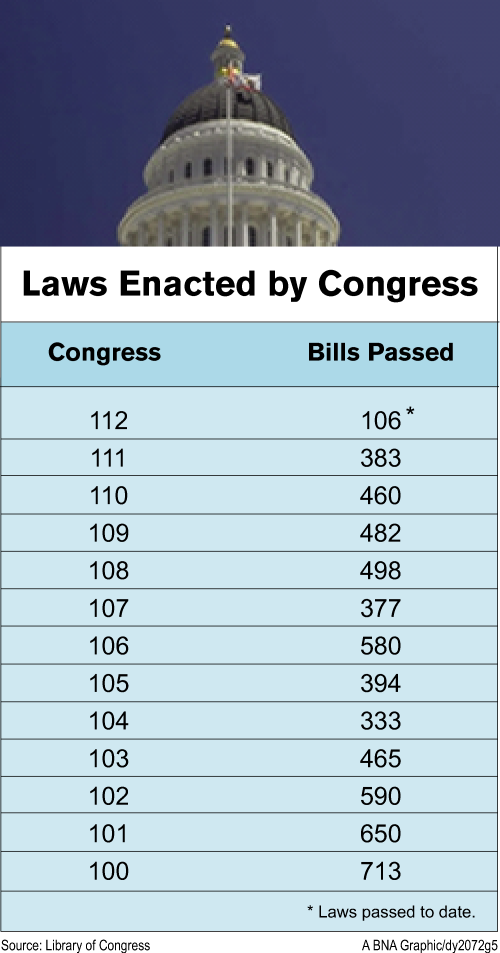
Republicans on Capitol Hill said the lack of enacted legislation was due to obstruction by Democrats who hold control of the Senate and a reduction in minor noncontroversial legislation, while a Democratic spokesman said it was due to lack of willingness to work on bipartisan efforts on the part of Republicans.
Don Wolfensberger, director of the Congress Project at the Woodrow Wilson International Center for Scholars, said the drop was due to the combination of fewer insubstantial bills as well as party gridlock.
‘Political Show Votes.’
Currently, public laws are numbered under a system using the Congress in which they were passed and the sequence in which they were signed into law. That convention has held since 1940, when joint resolutions were numbered separately, making comparisons to congresses after the 77th Congress somewhat more difficult.
The BNA analysis used data from the Library of Congress’s “Thomas” bill-tracking website, as well as lists of public laws enacted available on the website of the Government Printing Office and in federal “statutes at large” volumes. The slower pace of lawmaking in the 112th Congress was also reflected in the timing of the laws enacted so far. The 112th Congress’ 106th law in April was the latest to reach that number of any Congress dating back to the 77th.
All but the 104th Congress had seen their 106th law enacted within the first annual session of the Congress, while the 104th Congress saw its 106th law—the National Defense Act for fiscal year 1996—enacted on Feb. 20, 1996.
Don Stewart, spokesman for Senate Minority Leader Mitch McConnell (R-Ky.) said Democrats’ unwillingness to bring bipartisan legislation to the Senate floor was the reason for the low number of new laws. “Things like the JOBS act have been anomalies in the Senate,” he said.
“The Democratic leadership hasn’t been trying to pass legislation,” Stewart said. “We’ve spent I don’t know how much time on political show votes.”
The White House declined a BNA request for comment.
‘All Time Do-Nothing Champions.’
Perhaps unsurprisingly, Nadeam Elshami, spokesman for House Democratic Leader Nancy Pelosi (D-Calif.) attributed the lack of new laws to Republican intransigence.
“Why else would Congressional Republicans vote to end the Medicare guarantee, protect and expand tax breaks for billionaires, take our country to the brink of default and ignore the middle class and jobs unless they want to become the all time do-nothing champions?” Elshami said. “Their record driven by ideology and continued refusal to seek bipartisan solutions on behalf of the American people is helping reach their goal.”
Michael Steel, spokesman for House Speaker John Boehner (R-Ohio), said, “the new rules on commemoratives are largely responsible. And the Senate’s inaction, of course.”
Most Laws Noncontroversial, Wolfensberger Says.
For the Woodrow Wilson Center’s Wolfensberger, the significance of the slow pace of law-making in the 112th Congress is “very little.”
Wolfensberger, who served 28 years on Capitol Hill as a GOP staffer, said the lack of commemorative legislation—which commends, congratulates, or otherwise recognizes occasions, accomplishments, etc.—explained a good deal of the drop in enacted public laws, but so did the fact of what he called a “terribly divided government.”
“Most legislation enacted into law is minor, noncontroversial,” he said. Also, he said Republicans in general “don’t pride themselves on passing many laws.” In addition, modern bills often include several subjects, while older bills confined themselves to discrete issues, he said.
According to Wolfensberger, the percentage of laws passed in the House under suspension of the rules—a procedure which requires a two-thirds majority and is often used for noncontroversial bills—was often a large one in the past. In the 103rd Congress, the last Democratic House before the Republican takeover with the 1994 mid-term elections, bills passed under suspension in the House made up about 50 percent of enacted laws. By the 111th Congress, that had risen to 86 percent, he said.
Republicans cut down sharply on the number of so-called commemoratives when they took the reins in the House in 2011, effectively banning a roll call vote on any bill that “expresses appreciation, commends, congratulates, celebrates, recognizes the accomplishments of, or celebrates the anniversary of, an entity, event, group, individual, institution, team or government program; or acknowledges or recognizes a period of time for such purposes … .”
But even with commemoratives restricted to the occasional post office or federal court house naming, Wolfensberger said his figures show 69 percent of laws enacted for the 112th Congress still passed the House under suspension of the rules.
Wolfensberger said the sharpened rhetorical divide between Democrats and Republicans in recent decades has slowed legislating, citing the divide on a new transportation reauthorization bill (H.R. 7, S. 1813) in 2012. “That’s a big part of it,” he said.
Learn more about Bloomberg Law or Log In to keep reading:
See Breaking News in Context
Bloomberg Law provides trusted coverage of current events enhanced with legal analysis.
Already a subscriber?
Log in to keep reading or access research tools and resources.