


With patent reform legislation now stalled in Congress, state governments have taken the lead in tackling the problem of abusive patent assertion. Twenty-eight states have enacted or introduced laws to prohibit patent owners from sending letters that demand—in “bad faith”—payment of royalties from residents of those states.
This state-based approach to regulating patent demand letters has created a patchwork of laws that differ in the definition of “bad faith” and in the procedures and penalties available when a violation has occurred. This state-by-state variability means that a patent owner who plans to send a written licensing offer must be aware of the specific requirements of the recipient’s home state. This variability also raises a question whether a single federal law—establishing a uniform standard for all patent demand letters—would be an improvement over today’s patchwork of state laws.
The Status of Federal Reform
Since the passage of the Leahy-Smith America Invents Act in 2011, advocates of more reform have pressed Congress to go farther to curb abusive patent assertion. Congress has responded by introducing over a dozen bills containing provisions such as loser-pays fee-shifting, heightened pleading requirements, stay of customer suits and patent ownership transparency. To date, however, the only bill to have received a floor vote is the Innovation Act (H.R. 3309), which passed the House of Representatives on Dec. 5, 2013, by a recorded vote of 325 to 9187 PTCJ 259, 12/6/13.
Among other things, the Innovation Act addresses demand letters by providing that such letters cannot form the basis of willful infringement unless the letter identifies with particularity the asserted patent and the accused product or process, and explains how the product or process infringes the patent. The Innovation Act also contains a “sense of Congress” which states that “purposely evasive demand letters to end users” is an abuse of the patent system, is a deceptive practice and is an “exceptional” circumstance that may warrant fee-shifting.
Separately, patent demand letters are the focus of Sen. McCaskill’s bill, S. 2049, which would require the Federal Trade Commission to promulgate rules prohibiting unfair and deceptive patent demand letters and requiring demand letters to identify the patent number, the patent claims, a description of the manufacturer, the model number of each accused product or service, the identity of the patent owner and other required information87 PTCJ 1008, 3/7/14. This bill was referred to the Senate Committee on Commerce, Science, and Transportation, but the bill has not been acted upon.
The House Energy and Commerce Committee is considering its own version of demand letter legislation. A discussion draft bill circulated by Rep. Lee Terry was approved on July 10, 2014, to the full committee88 PTCJ 659, 7/11/14.
Despite Congress’ numerous hearings and pending bills, Congress has been unable to achieve compromise legislation that curbs abusive behavior without chilling legitimate business. To date, none of the federal bills has become law.
State-based Patent Reform
In May 2013, Vermont became the first state to enact a law that specifically targets bad-faith patent assertions. Since that time, 14 other states have passed such laws, and 13 more states have bills pending (including two awaiting the governor’s signature).
Following is an element-by-element comparison of the enacted or pending bills.
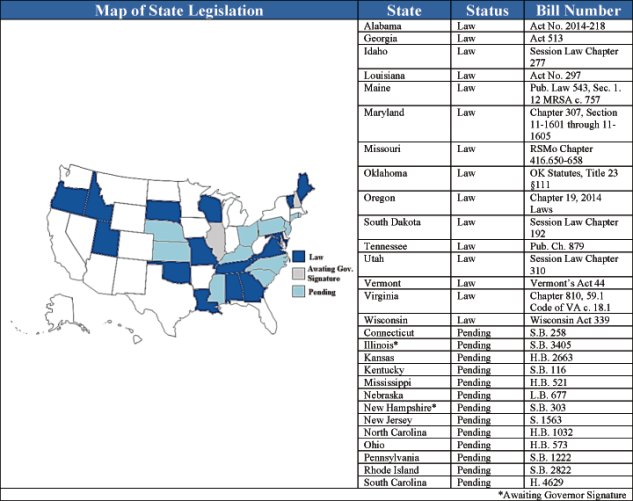
1. Indicia of Bad Faith.
Each state identifies a number of factors that a court will consider as indicative of “bad faith” on the part of the entity that sent the patent demand letter. Most of these factors relate to the information contained in the demand letter and the extent to which the sender conducted an infringement analysis prior to sending the letter.
[a] Patent Owner Name and Address. All 28 states that have enacted or proposed legislation provide that the failure to identify the name and address of the patent owner is indicative of bad faith.
[b] Patent Number. All 28 states provide that the failure to identify the patent number of the asserted patent is indicative of bad faith.
[c] Copy of Patent. One state (Wisconsin) additionally requires the demand letter to include a copy of the patent that is allegedly infringed.
[d] Patent Claims. One state (Utah) additionally requires the demand letter to identify the specific claims of the patent which are allegedly infringed.
[e] Factual Allegations. All 28 states consider it indicative of bad faith if the letter fails to set forth factual allegations concerning the specific areas in which a target’s products, services and technology infringe the patent.
[f] Failure to Provide Information within Reasonable Time. Twenty-three states (82%) consider it indicative of bad faith if a recipient of the demand letter requests any information that was missing from the letter and the sender fails to provide the requested information within a “reasonable period of time.”
[g] Prior Proceedings Involving the Patent. Two states (Wisconsin and Utah) require the demand letter to identify each pending or completed court or administrative proceeding involving the patent.
[h] Basis for Standing. One state (North Carolina) requires the demand letter to explain how the sender has standing to enforce the patent if the Patent and Trademark Office’s assignment database does not already identify the sender as the owner of the patent.
[i] Infringement Analysis. Twenty-four states (86%) consider it indicative of bad faith if the sender of the demand letter failed to conduct an infringement analysis comparing the claims of the asserted patent to the accused product or activity prior to sending the demand letter.
[j] Royalty Amount. Twenty-four states (86%) consider it indicative of bad faith for the sender to demand an unreasonable royalty amount.
[k] Period for Response. Twenty-three states (82%) consider it indicative of bad faith if the demand letter requires payment of a license fee in response to the letter within an “unreasonably short period of time.”
[l] Meritless, Deceptive, or Vague Assertions. Twenty-two states (79%) consider it indicative of bad faith if the letter asserts a “meritless” claim of patent infringement that the sender knew or should have known was meritless.
[m] Subjective Bad Faith. Two states (Idaho and Vermont) direct their courts to consider any evidence of subjective bad faith on the part of the sender.
[n] Prior Abusive Behavior. Twenty-one states (75%) consider a sender’s prior abusive behavior as indicative of bad faith. For example, some states consider whether the sender had previously sent a demand letter that lacked any required information (e.g., patent number, patent owner, factual allegations).
[o] False or Misleading Statements. Two states (Utah and Wisconsin) provide that false or misleading information in a demand letter is indicative of bad faith.
[p] False Threats of Litigation. Four states (14%) consider it indicative of bad faith if the demand letter falsely states that a litigation has been filed against the recipient.
[q] Prior Ruling of Invalidity, Unenforceability, Noninfringement. Four states (14%) consider whether the patent has been previously held invalid, unenforceable, or not infringed by the recipient’s activities in a final decision of a federal court or the PTO.
[r] No Right to License or Enforce. Four states (14%) consider it indicative of bad faith if the sender does not actually have a right to license or enforce the patent.
[s] Post-Expiration Compensation. Five states (18%) consider it indicative of bad faith to seek compensation for activities undertaken after the expiration of the patent.
[t] Misrepresentations of Fact. One state (Louisiana) considers it indicative of bad faith if the demand letter includes “misrepresentations of facts.”
[u] Non-Practicing Entity. One state (Kentucky) considers it indicative of bad faith if the sender does not actually practice the patent.
[v] Disclaimed Subject Matter. One state (North Carolina) considers it indicative of bad faith if the letter alleges infringement based on an interpretation of the patent claim that was disclaimed during prosecution.
[w] Multiple Diverse Recipients. One state (North Carolina) considers it indicative of bad faith if the same or similar demands were sent to multiple diverse parties without “reflecting on the differences in a reasonable manner.”
[x] Undisclosed Issues of Validity. One state (North Carolina) considers it indicative of bad faith if the sender fails to disclose any known issues affecting the validity of the patent.
[y] Unreasonable Injunction. One state (North Carolina) considers it indicative of bad faith if the sender is seeking an objectively unreasonable injunction.
[z] Any other factor the Court finds relevant. Twenty states (71%) provide a catch-all provision that bad faith may be evidenced by “[a]ny other factor the court finds relevant.”
[aa] Any other factor the Attorney General finds relevant. One state (Oregon) provides a catch-all provision that bad faith may be evidenced by “conduct that the Attorney General by rule identifies as evidence of alleging, asserting or claiming an infringement in bad faith.”
2. Indicia of Good Faith and Exceptions
As a counterweight to the foregoing indicia of bad faith, each state also provides a variety of factors that a court will consider as indicative of good faith on the part of the demand letter sender. Moreover, several states provide outright exceptions that completely shield certain classes of demand letter senders from liability.
[a] Demand Letter Descriptive Information. Twenty-three states (82%) consider it indicative of good faith if the demand letter contains descriptive information relating to the patent, the owner and necessary factual allegations.
[b] Infringement Analysis and Negotiations. Twenty-five states (89%) consider it indicative of good faith if the sender has conducted an infringement analysis and has attempted to negotiate “an appropriate remedy.”
[c] Substantial Investment. Twenty-four states (86%) consider it indicative of good faith if the sender has made a substantial investment in the use of the patent or in the production or sale of a product or item covered by the patent.
[d] Inventor or Original Assignee. Twenty-three states (82%) consider it indicative of good faith if the demand letter was sent by an inventor or original assignee of the patent.
[e] Universities and Technology Transfer Offices. Twenty-six states (93%) take into consideration whether the sender is an institution of higher learning or a technology transfer organization associated with an institution of higher learning.
[f] Previous enforcement. Twenty-three states (86%) consider it indicative of good faith if the sender has demonstrated good faith business practices in previous efforts to enforce the patent, or if the party has successfully enforced the patent or a substantially similar patent in a previous litigation.
[g] Hatch-Waxman. Thirteen states (46%) provide a complete exemption for demand letters involving an act of infringement under the Hatch-Waxman provision
[h] Biological Products. Seven states (25%) provide a complete exemption for demand letters that involve biological products under
[i] Pesticides, Plants, FDCA. One state (North Carolina) provides a complete exemption for demand letters that involve subject matter governed by
[j] Publicly Traded Companies. One state (South Dakota) provides a complete exemption for any corporation traded on a public stock exchange or any entity owned or controlled by such a corporation.
[k] Health Care Institution. One state (Wisconsin) provides a complete exemption for demand letters sent by a health care or research institution that has annual expenditures of at least $10,000,000 and that receives federal funding, and any organization that is owned or controlled or operated by such an institution. Wisconsin also provides a complete exemption for demand letters involving a patent on a device or a component thereof that is subject to approval by the Federal Food and Drug Administration or the Federal Department of Agriculture.
[l] Any other factor the court finds relevant. Twenty-two states (79%) provide a catch-all provision that good faith may be evidenced by “[a]ny other factor the court finds relevant.”
[m] Any other factor the Attorney General finds relevant. One state (Oregon) provides a catch-all provision that good faith may be evidenced by “conduct that the Attorney General by rule identifies as evidence of alleging, asserting or claiming an infringement in good faith.”
3. Procedures and Relief
As the following section demonstrates, the procedures and remedies available under state law vary from state to state.
[a] Authority to Sue. All 28 states authorize the state’s attorney general to bring an action against the sender of a bad faith demand letter. One state (Maryland) also allows the state’s consumer protection division to enforce the law. Twenty-seven states (96%) have also created a private right of action that allows the recipient of a bad faith demand letter to sue the sender. One state (Virginia) only allows its attorney general to enforce the law and does not create a private right of action.
[b] Equitable Relief. Twenty-two states (79%) provide for equitable relief for a prevailing plaintiff.
[c] Actual Damages. Twenty-seven states (96%) allow a prevailing plaintiff to recover actual damages against the defendant. One state (Missouri) sets a damages floor, providing that a prevailing plaintiff shall recover either actual damages or $10,000, whichever is greater.
[d] Punitive or Exemplary Damages. Twenty-four states (86%) allow a prevailing plaintiff to recover punitive or exemplary damages against the defendant.
[e] Attorneys’ Fees. All 28 states allow a prevailing plaintiff to recover attorneys’ fees against the defendant. One state (Nebraska) allows a prevailing plaintiff to recover attorneys’ fees only if the defendant’s infringement claim was found to be groundless or deceptive.
[f] Court Costs. Twenty-seven states (96%) allow a prevailing plaintiff to recover court costs.
[g] Bond Requirement. Twenty-one states (75%) allow the court to require the defendant to post a bond if the plaintiff files a motion and the court finds that the plaintiff is likely to prevail on the merits.
[h] Statute of Limitations. Two states (Idaho and Alabama) provide a statute of limitations.
[i] Notifying the Attorney General. One state (Nebraska) requires any entity that sends more than 25 demand letters in a single calendar year to notify the attorney general’s office of this fact.
Conclusion
The current state-based approach to regulating patent demand letters has resulted in a patchwork of legislation that varies widely between states. Patent owners will need to carefully navigate these state laws if they wish to avoid potentially costly liability when attempting to license their patents.
If Congress eventually decides to establish a single federal standard, these 28 state laws provide a myriad of options from which Congress may choose.
Learn more about Bloomberg Law or Log In to keep reading:
See Breaking News in Context
Bloomberg Law provides trusted coverage of current events enhanced with legal analysis.
Already a subscriber?
Log in to keep reading or access research tools and resources.