


A record setting JPY19.5 billion (US$197m) worth of counterfeit goods were seized by Japanese customs in 2012. Even with strict Japanese anti-counterfeiting laws and well-established customs practice and procedures, the war against counterfeiting is a never-ending battle, especially since the vast bulk of counterfeit goods are sold on the internet.
In 2012, the annual number of counterfeit import seizures executed by the customs authorities in Japan exceeded 20,000 for the fifth consecutive year
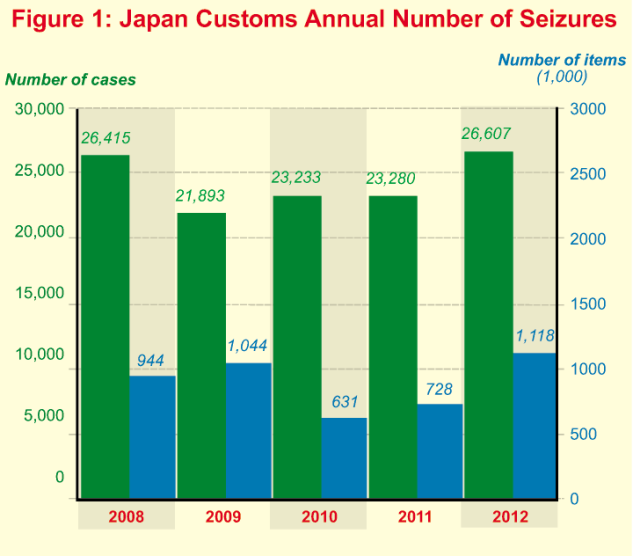
Table 1 shows the estimated value of seized counterfeits by Japanese customs in 2012, with handbags and apparel topping the list of the most popular counterfeit goods seized.
Japanese customs agencies have noted the shift towards using international mail and express courier services
Previously, most counterfeit goods were shipped from overseas via large containers and then sold in the country. The increase in online shopping has changed that “business model” and counterfeiters are now selling these items through websites and shipping them directly to the consumer. The first bulwark defense is the Japanese customs at the border and their work is clearly cut out for them.
The high number of customs seizures of counterfeits is a direct result of the Japanese Government seeking to tighten customs procedures to “prevent counterfeiting and the import of pirated goods” and stanch the multi-million dollar counterfeiting-related losses suffered by Japanese companies.
Japan Police Anti-Counterfeiting Statistics
These customs seizure trends have also been reflected in Japanese police statistics. Figure 2 shows that 59.8% of all criminal counterfeit cases in Japan had their origins from the internet. The overwhelming majority of criminal counterfeit items seized by police were Chinese-made (94.5%) but only a miniscule portion were of domestic origin.
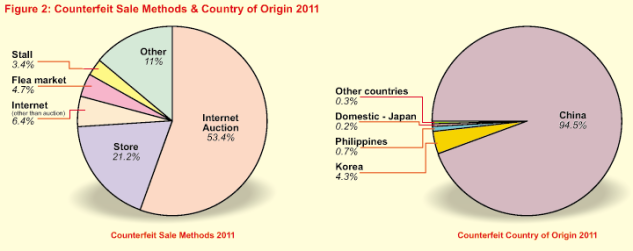
The growing trend in the online sale of counterfeits is not a mere domestic problem but actually a worldwide one. It has been reported that online counterfeit sales “will soon surpass the volume of such goods sold by street vendors and in other physical markets” and that “piracy over the internet is rapidly supplanting physical piracy in many markets around the world”
Anti-Counterfeiting Weapons
By collaborating closely with Japanese customs, brand owners have an effective and powerful weapon to stem the flow of counterfeit goods. Customs can stop the importation of products that infringe a trademark, utility model, design, or patent registered or issued in Japan. To do so, the aggrieved party must either be (a) the owner of such registrations or issuances, or (b) the holder of an exclusive license with respect to these rights. Copyrights do not need to be registered in Japan for customs to act and copyrights registered in the US may be submitted as evidence of ownership.
Customs may also stop the importation of goods infringing unregistered intellectual property, based on the Japanese Unfair Competition Prevention Law, but this is more difficult than with registered intellectual property due to the added burden of proving to customs that the feature, mark, logo or design to be protected is indeed protectable under Japanese law. For intellectual property rights that have been applied for but are as yet unregistered, this can be an option worth pursuing in some cases.
Japanese law also offers rights holders the pre-emptive ability to request customs to “suspend” (i.e. enjoin) the entry of counterfeit goods into Japan. The application does not have to be made with respect to specific goods, but may be a general application. Based on this general application, if customs comes to learn of suspected counterfeit goods entering the country, it will stop the goods and contact the importer and the rights holder regarding shipment. The rights holder is then invited to inspect the goods to determine authenticity.
Japanese brand owners have an additional weapon to combat online counterfeiting as a result of the landmark Intellectual Property High Court of Japan decision in the 2012 Rakuten case (see
There, the court outlined the conditions under which an online mall operator would be held liable for trademark infringement for sales on its platform by third party store owners and when that the online shopping mall operator could be required to pay damages if it neglects to delete from its website items that violate trademark rights within a reasonable amount of time (Perfetti Van Melle SpA v. Rakuten, Case No. 2010 (Ne) 10076, February 14, 2012).
Japanese brand owners are now able to contribute to stopping online counterfeiters by reporting the online sale of counterfeits and infringing items on Japanese retail sites like Rakuten and Yahoo! Japan as a result of the Rakuten decision. This, coupled with the vigilant Japanese customs inspections and seizures of counterfeit goods, will ensure that the world’s third largest economy is a relatively safe oasis against online counterfeiting, though brand owners should by no means let their guard down.
Learn more about Bloomberg Law or Log In to keep reading:
See Breaking News in Context
Bloomberg Law provides trusted coverage of current events enhanced with legal analysis.
Already a subscriber?
Log in to keep reading or access research tools and resources.