


In a recent decision, the Technical Board of Appeal of the European Patent Office was required to decide a case involving a parent patent and its divisional application (Case T-1496/11). In the opposition proceedings against the parent patent, the board concluded that Claim 1 of the parent patent did not enjoy priority because it was generalized over the content of the priority document, whereas the divisional application (introduced into the proceedings as document G25) did enjoy priority.
The board concluded:
“In view of the foregoing, the subject-matter of Claim 1 (main request) is only entitled to the filing date of 8 October 1997.”
“The divisional application G25 of the patent in suit discloses an embodiment…. The description of this embodiment is identical to that provided in the priority document (page 9, lines 19 to 27 and figures 1 and 2). This embodiment of the divisional application G25 is therefore entitled to the claimed priority date of 10 October 1996 and thereby anticipates the subject-matter of Claim 1 (main request) which is only entitled to the filing date of 8 October 1997” (emphasis added).
This decision raises considerable concerns with respect to the applicability of EPC Article 54(3) between parent and divisional applications — which the present decision affirmed without any further consideration.
The problem may be illustrated by a hypothetical case as follows:
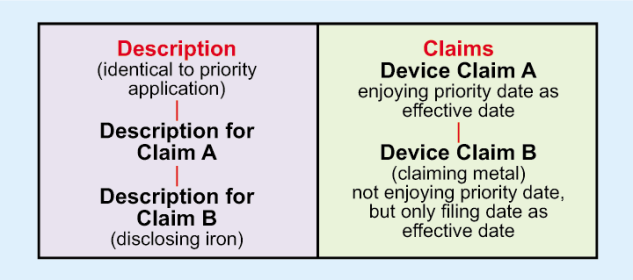
In this hypothetical case we have a common application claiming priority. The description is identical to that of the priority document. Claim A (directed to a device) is identical to that of the priority document and thus enjoys priority. Claim B (added with filing of the application and also directed to a device) also claims an embodiment in the description, however it contains a generalization (in this example only iron was mentioned in the description, whereas metal is claimed), and thus does not enjoy priority.
As long as both claims stay within the same application, we simply have Claim A enjoying priority and Claim B not enjoying priority peacefully coexisting in the same application without any conflict between them. EPC Article 54(3) obviously does not apply because we do not have any earlier and later application.
However, the examiner now invokes EPC Rule 43(2) and argues that (in the absence of any of the three exceptions) only one device claim may stay in this application. Therefore, the applicant files a divisional application for Claim A and leaves only Claim B in the parent application:
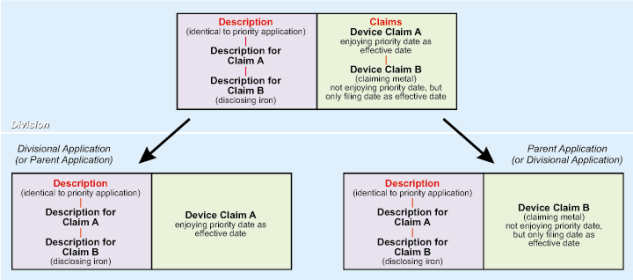
This division has no material background whatsoever, but only serves to satisfy the EPC such that for any additional independent claim in the same category (just like for any of a plurality of inventions) fees have to be paid to the EPO.
Following the rationale of the Board of Appeal in T-1496/11, all of a sudden the same claims which coexisted in the common application without any conflict would now be in conflict under Article 54(3).
As only a procedural division of the application has been carried out, which should have no material effect (i.e. not invalidate claims by the mere act of the division), such result would be unjustified.
Established Case Law and Applicability of Article 54(3)
Established case law does not require the application of Article 54(3) between parent and divisional applications.
It certainly has become a generally accepted principle that, once a divisional application has been validly filed, it becomes separate from the parent application. Thus once the conditions of EPC Article 76(1) had been met, the divisional application would be examined as an application quite separate from the parent application and had itself to comply independently with all the various requirements of the EPC.
This finding, however, was directly related to the fact (see Cases T-441/92, T-1055/92, T-284/95) that the papers of the parent application cannot be used to satisfy EPC Article 123(2) requirements of the divisional application. Therefore, what had not been disclosed in the papers filed for the divisional application cannot be claimed therein, even though it may have been disclosed in the parent application (but not taken along in the divisional papers).
This, however, does not mean that the history of the divisional application may be eradicated once it was filed. Quite to the contrary, it actually means that a claim amendment in the divisional application will always stay open, according to EPC Article 76(1), also to objections for not having been originally disclosed in the parent application. Thus, exactly under this very case law, the divisional application always remains dependent on the contents of the parent application.
Thus the parent and divisional applications do not have to be regarded as non-related applications.
Preparatory Notes for EPC and Applicability of Article 54(3)
The preparatory work for the EPC as shown in the “preparatory materials” advocates against an application of EPC Article 54(3) between parents and divisionals.
The purpose and thus scope of Article 54(3) has been clearly explained by the Enlarged Board of Appeal in G1/03 (OJ 2004, 413) with reference to the “preparatory materials” underlying the EPC.
As explained in all detail under 2.1.1 of the decision in OJ 2004, pp 428–431, Article 54(3) is directed to avoid double-patenting (see OJ 2004, 430). The avoidance of double-patenting is best achieved by the “prior claim approach” (a granted European patent with an earlier effective date is in conflict with a later European application only as far as the scope of the granted claims of the European patent are coextensive with the scope of the claims in the later application). This prior claim approach still is practiced, e.g. in Switzerland (hence Switzerland has provided under EPC Article 135(1)b for a national continuation of the grant procedure in case a European patent designating Switzerland was revoked under Article 54(3)).
The majority of the EPC contracting states, however, voted for the “full contents approach” (artificially assuming the not pre-published application to be prior art, but only as far as novelty is concerned) as this is easier to handle (see OJ 2004, 429, 430). This vote was in the face of creating a “self conflict” problem which would have been avoided from the outset by the “prior claim approach”. The Enlarged Board of Appeal explained:
“[I]t is clear that the intention was to restrict the effect of the earlier application as far as possible in order to avoid unfairness resulting from the concept of a fictional publication. Delimitation against an earlier application was a traditional and well-known exercise under the prior claim approach…. The result of the examination of the prior application was decisive for the question of what was left for the later application and, for the purpose of defining this remaining portion, it was permissible to add a disclaimer to the original claims in the later application for the subject matter protected in the prior patent…. It may be assumed that the highly controversial whole contents approach, as described above, would never have been accepted in the preparatory work to the EPC if it had been suggested not only to extend to the state of the art to be considered for novelty by a legal fiction but also to do away with the practice of delimitation against earlier applications” (emphasis added).
Likewise the “highly controversial whole contents approach” would probably not have been accepted if it were understood to be applicable between parent and divisional applications/patents of the same family (which was never imagined during preparation of the EPC).
Conclusion
Therefore, in conclusion, the full contents approach under EPC Article 54(3) should be interpreted such that its effects resemble as closely as possible the substantive effects of the prior claim approach. Also this suggests that Article 54(3) should not be applied between parent and divisional applications/patents.
Learn more about Bloomberg Law or Log In to keep reading:
See Breaking News in Context
Bloomberg Law provides trusted coverage of current events enhanced with legal analysis.
Already a subscriber?
Log in to keep reading or access research tools and resources.