


Apple and Samsung are currently embroiled in a multi-jurisdictional “battle royale” regarding their smart phone and tablet devices. At the center of these disputes are Apple’s allegations that Samsung has infringed its world-famous designs.
In Australia and Germany, Apple has recently secured injunctions (
This all changed when recently the transcript from the Oct. 13 preliminary injunction hearing was made available. While in the aftermath of the hearing there were several news stories commenting on what allegedly transpired at the hearing, upon closer examination it appears that the accounts largely mischaracterized the proceedings and left unreported several key facts, including the fact that presiding Judge Lucy H. Koh stated on the record that she believed Apple’s asserted design patent (D504,889), which allegedly covers Apple’s iPad, to be invalid.
In short, this article seeks to: (1) provide the facts and background necessary to understand the current design patent dispute, (2) extract the critical “news” from the preliminary injunction hearing, and (3) offer insights into the merits along with potential outcomes.
To be sure, much can be learned about the future of this high-profile design patent case—indeed, the highest profile U.S. design patent case ever—from the preliminary injunction hearing, including the current strategies of the litigants and proclivities of the presiding judge.
I. Facts and Background of Current Dispute
In April, Apple sued Samsung for, among other things, patent infringement. Apple’s complaint, which has been amended once, asserts eight utility patents and seven design patents directed at “electronic devices” and more specifically, cellular phones and tablet devices.
In short, design patents protect appearance; utility patents protect function. A design patent, for example, could be used to protect a cellphone’s aesthetic appearance, while a utility patent could be used to protect the cellphone’s internal circuitry.
Even though the court had already granted Apple’s request for an expedited trial (now set to commence June 30, 2012), on July 1, Apple filed a motion for a preliminary injunction with respect to three of the design patents, and one of the utility patents. (A preliminary injunction, if entered, would halt Samsung’s sales of the accused products during the pendency of the case; without the preliminary injunction, Samsung could continue to sell the accused products while the case progresses, up until any final injunction was ordered).
The rationale behind Apple’s preliminary injunction motion, as is the case with most all motions for preliminary injunction, was that Apple cannot wait until the final resolution of the case on the merits because by then, even if it wins, irreparable harm will have been inflicted upon it. In essence, Apple argues, the longer justice is delayed the more irreparable damages will be incurred as a result of Samsung’s infringement.
To prevail on its preliminary injunction motion, for each asserted patent, Apple must show that it is likely to succeed in establishing that (1) there is infringement, and (2) the patent is not invalid, as Samsung contends. In addition, Apple must establish that unless the court issues an injunction immediately, Apple will sustain “irreparable harm,” and that such injunction favors the public’s interest. Given the gravity of the request in a preliminary injunction case, the burdens are quite high for a moving party.
The three Apple design patents implicated in its preliminary injunction motion are D593,087, D618,677 and D504,889. For each of the three patents, Apple’s lead industrial designer Jonathan P. Ive and the late Steve Jobs are both among the fourteen inventors listed on the face of the patents.
The asserted D'087 and D'677 patents are both directed to the appearance of Apple’s iPhone. The asserted D'889 patent is directed to the appearance of Apple’s iPad. I will briefly discuss each in turn below.
A. The D'677 Patent
The D'677 patent, which claims an earliest priority date of Jan. 5, 2007, discloses a single embodiment directed to the appearance of a front face of a device, where the front face is colored black. Note the crosshatch drafting convention in the drawings, along with the statement in the specification that the cross-hatching denotes the “designation for the color black.”
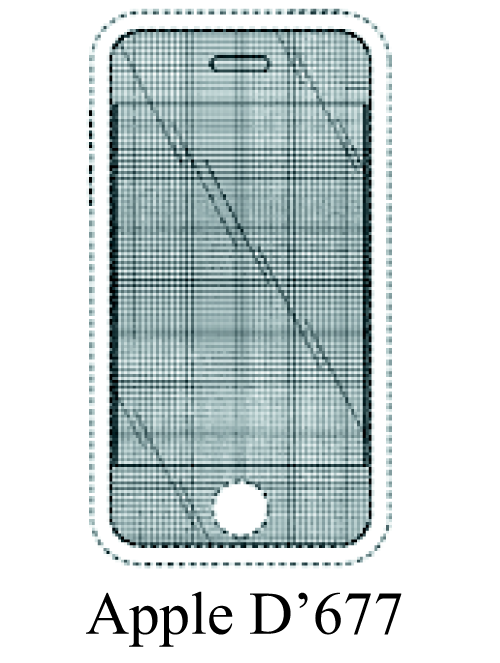
No other sides of the device are claimed. Figure 1, however, does provide a prospective view, which is important because it disclose the (lack of) contour on the front face. A simple top plan view often does not provide enough information so that the contour of the surface can be discerned. By way of example, a single top plan view showing two concentric circles does not provide sufficient information to discern whether the inner circle is co-planar with the outer circle.
Here, the perspective view shows that the front face is flat, and not curved. Further, inasmuch as the upper speaker (which roughly has a elongated oval shape) is shaded over with the same cross-hatching as the rest of the front face, the speaker area is co-planar with the rest of the front face.
As discussed below, without this view (and related surface shading), it is impossible to discern the contour of the claimed design without resorting to (impermissible) conjecture. In this instance, Apple properly included the perspective view and necessary shading to fully disclose the (lack of) surface contours on the front face.
B. The D'087 Patent
Unlike the D'677 patent, which discloses only a single embodiment, the D'087 patent, which claims an earliest priority date of Jan. 5, 2007, discloses six different embodiments. All embodiments are directed at a front face with an outer bezel for an electronic device.
None of the embodiments claim any specific color, and, significantly, none of the embodiments contain any surface shading. As shown below, the differences between the D'087 patent’s six various embodiments reside in various combinations of dotted and solid lines to depict (1) the upper speaker, (2) the screen border, and (3) the home button.
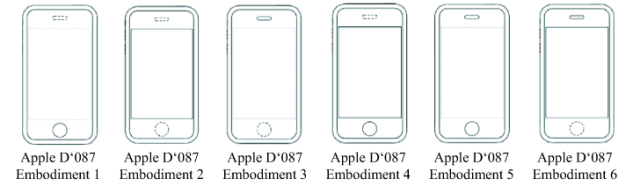
For example, and as shown above, in Embodiment 1, the speaker and screen border are depicted in dotted lines (i.e., “unclaimed”), while the home button is depicted in solid lines (i.e., “claimed”). Conversely, in Embodiment 6, the speaker and screen border are depicted in solid lines, while the home button is depicted in dotted lines.
Below is a chart summarizing the various combinations of claimed and unclaimed subject matter set forth in the 6 embodiments of the D'087 patent.
It should be remembered that while multiple embodiments may be included in the figures, design patents are permitted to have only a single claim. Apple’s sophisticated and strategic use of multiple embodiments and dotted lines is used to increase the scope of the single claimed design.
C. The D'889 Patent
The asserted D'889 patent, which claims an earliest priority date of March 17, 2004, is directed to the appearance of Apple’s iPad. (“iPad Patent”).
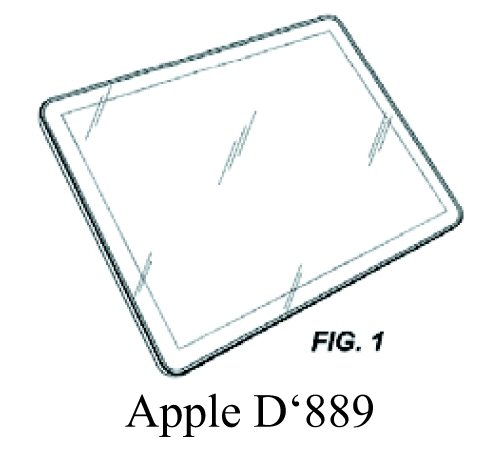
The D'889 patent discloses a single embodiment directed to the entire appearance of the tablet device. No portion of the tablet is disclaimed in the specification and all six sides of the tablet are claimed. (i.e. top, bottom, front, rear, right side, left side.)
Significantly, Figure 1 includes “oblique” (i.e., diagonal) surface shading lines over the entire front face of the device.
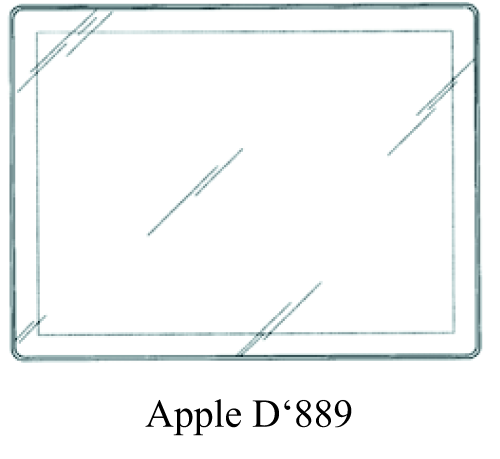
According to Patent and Trademark Office practice, oblique lines are required to depict transparent, translucent, highly polished, or reflective surfaces. Manual of Patent Examining Procedure (MPEP) 15.48, Surface Shading.
Presumably, Apple used this drafting convention in the drawings to specifically indicate that glass covers the entire front face of the device. The inclusion of the oblique lines in the drawings is effectively a claim limitation, which, of course, limits the scope of the claim when deciding both infringement and validity.
In other words, just as the cross-hatching in the D'889 patent limits the claim to a front face that is colored black, the oblique surface shading lines of the patent limit the claim to a device having a front face that has a transparent, translucent, highly polished, or reflective surface. I will discuss the potential significance of this “claim limitation” later in the article.
D. Insights Into Design Prosecution Issues
Before turning to the discussion on infringement, I will briefly provide some commentary on the significance and implications of the multiple embodiments, surface shading, and dotted lines used in the asserted design patents.
It should be noted that although I am using the shorthand terms “iPhone Patents” and “iPad Patent” for purpose of this article, these are not the only design patents that Apple has on its iPhone and iPad. Indeed, ever since Apple embarked on its very sophisticated and aggressive design patent strategy in the 2008-09 time frame, Apple has sought to acquire multiple design patents for many of its products, including not just design patents on the design for entire products, but also design patents on subparts and svarious combinations of subparts, for such product.
In view of this “blue-ribbon” design patent portfolio, when the moment came to assert infringement against Samsung, Apple literally had hundreds of design patents to choose from.
i. Multiple Embodiments: A Two-Way Street
To establish infringement of the D'087 patent, Apple need only show that one of the six embodiments of the D'087 patent is infringed. It appears from Apple’s motion for preliminary injunction (including its supporting memorandum and expert report) that Apple is relying on Embodiment 6 of D'087 for its infringement case, where the speaker and screen border are in solid lines, and the home button in dotted lines.
Apparently, Apple is proceeding with Embodiment 6 because neither the Samsung Galaxy S 4G, nor the Infuse 4G, have home buttons (or anything resembling a home button), but both Samsung accused products do have somewhat similar speaker and screen border designs.
By having six embodiments from which to choose, all including a liberal use of dotted lines, Apple was able to strategically select an embodiment that eliminated several of Samsung’s potential noninfringement arguments (i.e., lack of a home button, any differences in the side, back, top, and bottom views, etc.) and thereby significantly increased Apple’s chances of prevailing on infringement. Indeed, in the current dispute, in response to Apple’s charges of infringement, Samsung hardly argued noninfringement.
Koh, addressing Samsung’s counsel at the preliminary injunction hearing, noted Samsung’s lack of noninfringement arguments stating, “I noticed in the briefing you hardly touched, really, infringement…” (Tr. at 49.) At least for infringement (not necessarily validity), and based on Koh’s initial statements on infringement at the hearing, it appears that Apple’s design patent prosecution strategy (to increase design patent coverage so to maintain maximum flexibility when pursuing infringers) has worked.
This type of multiple embodiment claiming with liberal dotted line practice is a relatively little used, but effective, claiming technique to provide increased scope for a design patent. Of course, just as with utility patent claiming, while increased claim scope might ensnare more infringers, it also brings with it increased exposure to prior art.
Worse yet, because there is only one claim allowed in a design patent, and all embodiments must be patentably indistinct, if any one of the embodiments is anticipated or rendered obvious, the entire claim (and thus entire design patent) is invalidated. See Ex Parte Appeal No. 315-40,
As discussed below, in view of the prior art introduced by Samsung, and in view of the broad claiming strategy employed by Apple, at least one of the embodiments of the D'087 patent might be susceptible to a prior art invalidity challenge, thus invalidating the entire design patent.
One way to mitigate this “all or nothing” proposition (as established in Ex Parte Appeal No. 315-40 and In re Klein) is to file each embodiment in its own separate design patent application, thereby shielding each embodiment from any prior art issues that any other embodiments might encounter. A review of Apple’s design patent filings shows that in many instances for a given product Apple actually employs both approaches, filing multiple embodiments applications and also “stand-alone” applications (i.e., applications with a single embodiment).
Of course, while filing separate design patents for each embodiment is more expensive (i.e., more application fees, search fees, issue fees, etc.), if a particular design is highly valuable (e.g., a company’s commercialized design), applicants should consider filing the embodiment as a stand-alone application, and if it makes sense in the particular circumstances, applicant may also wish to file the embodiment along with any other embodiments in a multiple embodiment application.
Incidentally, the European Registered Community Design (“RCD”) system does not follow the “all or nothing” approach; rather, an applicant can include multiple designs in a RCD application without fear that if one design fails all of the registered designs in the same application necessarily fail. Each design will be judged on its own merit, and only the invalidated design will fail.
Appreciation for this fundamental difference is critical for foreign design applicants to understand, particularly in view of the United States’ upcoming implementation of the Hague Agreement Concerning the International Deposit of Industrial Designs and the expected uptick in foreign applicant seeking to file design patent applications in the United States.
ii. Dotted Lines and Surface Shading:
Clarity Reigns Supreme
Design patent applicants need not claim an entire article of manufacture design. In re Zahn,
Sophisticated use of this technique (particularly in conjunction with multiple applications) can greatly increase the effectiveness of a strategic design patent prosecution strategy. However, in addition to depicting the unclaimed subject matter in dotted lines, an applicant is required to include a statement in the specification to make it clear if the applicant is actually disclaiming portions shown in dotted lines. See MPEP 1503.03 III Broken Lines (“Structure that is not part of the claimed design, but is considered necessary to show the environment in which the design is associated, may be represented in the drawing by broken lines… Unclaimed subject matter must be described as forming no part of the claimed design or of a specified embodiment thereof.”); see also MPEP §1503.02.
Failure to include this written statement could result in the dotted lines being deemed part of the claimed design. See Bernardo Footwear v. Dillard’s, 4:2007cv00963 (S.D. Tex. 2007), aff’d on appeal (“The stitching is depicted by a broken line, but the patent does not make it clear that the broken lines are not stitching that is part of the design sought to be patented as required by MPEP § 1503.02. Consequently, in this case where the broken lines create the visual image of decorative stitching, the court construes the broken lines as part of the claimed design as depicted in the drawing.”).
Worse yet, and if the claim is held unclear, the claim might be invalid under
All three of the asserted Apple designs patents use dotted lines in the drawings, but (at least on their face) only the D'087 patent provides an explanation as to their meaning.
For example, in the D'677 patent, the speaker is depicted in solid lines, and thus claimed, whereas the home button is depicted in dotted lines, and thus (presumably) not claimed. I say “presumably” because the specification (set forth on the face of the D'677 patent) is silent as to the meaning of the dotted lines.
Similarly, the outer bezel (i.e., the border portion that circumscribes the front face) is depicted in dotted lines, but there is no statement in the specification disclaiming the dotted lines for the bezel. Thus, technically speaking, because it is somewhat unclear whether the home button or bezel are claimed or unclaimed, the D'677 patent may be susceptible to a potential invalidity challenge under
In Apple’s defense, the prosecution history of the D'677 does include the examiner’s amendment arguably disclaiming the dotted lined areas. It is unclear why this disclaimer did not make it on the face of the D'677 patent.
Since the prosecution history is deemed intrinsic evidence, Apple may be able to point to this statement in the prosecution history to thwart any such Section 112 argument.
Another drawing-related issue is that the D'087 patent lacks any surface shading, or details in the perspective view, to disclose the contour of the speaker or home button. Because of this lack of surface shading and detail in the perspective view, it is unclear whether the speaker and home button are co-planar relative to the rest of the front face.
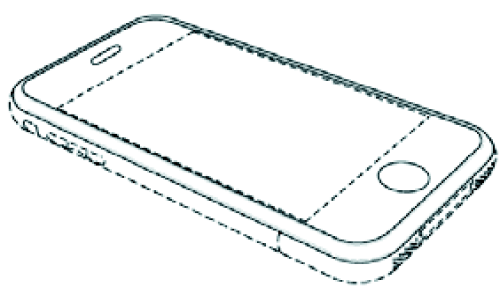
In briefing on its motion for preliminary injunction, Apple refers to the speaker area as a “slot,” connoting that it has contour and depth. If, indeed, Apple intended to claim a change in contour (i.e., depression) in the front face, it should have used surface shading to indicate such contour. See MPEP Section 15.49, Surface Shading Necessary (“The drawing figures should be appropriately and adequately shaded to show clearly the character and/or contour of all surfaces represented. This is of particular importance in the showing of three (3) dimensional articles where it is necessary to delineate plane, concave, convex, raised, and/or depressed surfaces of the subject matter, and to distinguish between open and closed areas.”).
Thus, because the contour of the speaker and home button is unknown, the D'087 patent may be susceptible to a potential invalidity challenge under
As an aside, it is noted that Apple’s initial application, from which the D'677 is derived, did not contain any surface shading. Apple would likely have run into a new matter rejection if it tried to add surface shading (depicting a change in contour) any time after filing. See In re Daniels,
With respect to the D'889 patent, the only area of the device that is in dotted line is the outer border of the screen.
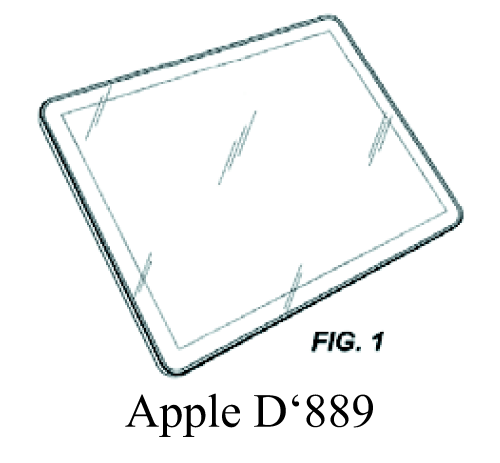
However, it is unclear as to whether or not this border is part of the claimed design or not.
As discussed above, the applicant is required to include a statement in the specification to make clear whether the dotted lines are part of the claimed design or not. See MPEP 1503.02. Here, there is no mention in the D'889 patent’s specification (or prosecution history) as to whether the outer border of the screen, depicted in dotted lines, is intended to be claimed or unclaimed.
Thus, technically speaking, because there is no indication that the dotted line is disclaimed, the default rule is that the depicted feature (i.e., a dotted line rectangle) is part of the claimed design. It will be interesting to see how both Apple and Samsung use the drawing issue when addressing issues related to both infringement and validity.
As a take-away, if a design patent applicant is going to use dotted lines to disclaim portions of a design, the patent applicant should make sure that the specification includes a statement indicating the intention to disclaim such portions.
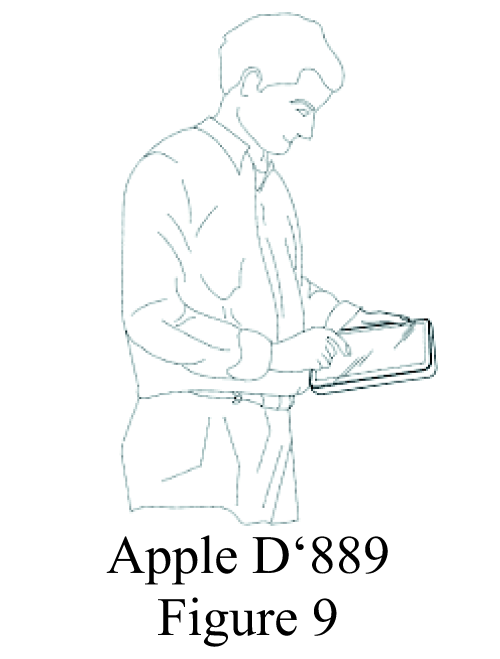
While on the topic of solid lines versus dotted lines, it is interesting to note that Figure 9 shows an “exemplary diagram” of a hypothetical user using the claimed tablet. During prosecution, the examiner requested that Apple reduce the hypothetical to dotted lines, rather than depicting him in solid lines.
In the published D'889 patent, while the user is mostly in dotted lines, the user’s left hand is still indicated in solid lines. Did Apple intended to include the left hand as part of the claimed design? While the answer is almost assuredly “no,” in the world of design patents, because the drawings are effectively the claim, errors such as these can prove to be costly.
It will be interesting to see whether Samsung raises this argument.
D. Infringement: How Close Is Too Close?
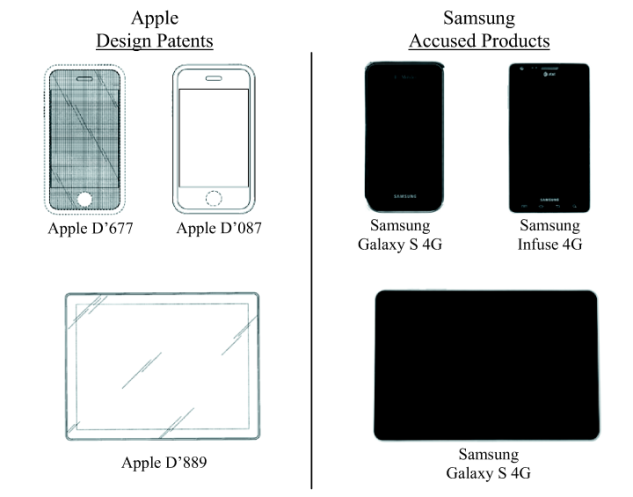
In its motion for preliminary injunction, Apple seeks to enjoin (1) Samsung’s Galaxy S 4G and Infuse 4G phones for alleged infringement of the iPhone Design Patents, and (2) Samsung’s Galaxy 10.1 tab for alleged infringement of the iPad Patent. (Apple also has alleged that Samsung’s Galaxy S 4G and Infuse 4G phones and Galaxy 10.1 tab all infringe Apple’s utility patent U.S. Patent No. 7,469,381.). Apple’s asserted design patents and Samsung’s accused products are set forth below.
To prove design patent infringement, a patentee must satisfy the “ordinary observer” test:
“in the eye of an ordinary observer, giving such attention as a purchaser usually gives, two designs are substantially the same, if the resemblance is such as to deceive such an observer, inducing him to purchase one supposing it to be the other, the first one patented is infringed by the other.”
Gorham Co. v. White, The Federal Circuit recently held that the ordinary observer test is the sole test for design patent infringement. See Egyptian Goddess Inc. v. Swisa Inc.,
I will discuss the case developments regarding infringement in the next section, and in view of the preliminary injunction hearing.
II. “News” From the Preliminary Injunction Hearing
Contrary to some earlier reports, Koh did not officially “rule” or “hold” at the Oct. 13 preliminary injunction hearing that Samsung infringes any of the asserted Apple design patents. Rather, she was careful to say that her statements during the hearing were only “tentative thoughts.” (Tr. at 97.) She indicated that she hoped to “issue an order fairly promptly.” (Id.)
A. Koh States That She Believes iPad Design Patent Is Infringed
While not a final ruling, Koh did state at the hearing that the accused Samsung Galaxy 10.1 tab “looks almost identical” to the Apple iPad.
At what must have been a high drama courtroom moment, Koh held up the iPad and Galaxy tablets and bluntly asked Samsung’s counsel, “Tell me which one is Samsung and which one is Apple? … Can you tell me?” (Tr. at 48.) Samsung counsel responded “Not at this distance, your Honor.” Id.
Next, and more properly discussing a patent-to-product comparison, Koh further added, “I would say that these tablets, I think they do infringe.” (Tr. at 64.) While none of this amounts to a holding, Koh appears to have all but made up her mind on infringement of the D'889 patent.
The preliminary injunction analysis does not end there. As discussed above, Apple needs to show that it will likely succeed on not only the issue of infringement, but validity too.
Further, to be clear, Koh’s courtroom statements on infringement were only directed at the iPad Design Patent vis-à-vis the Samsung Galaxy 10.1 tab. Koh was silent on whether she was leaning towards finding infringement with respect to the Samsung’s Galaxy S 4G and Infuse 4G phones.
As an aside, this case seems to suggest that in the initial years of introducing a new product category (e.g. tablets, touch phones, etc.), differences in the design of a later party’s product may have to be greater in order to avoid design patent infringement. For instance, with respect to tablets, the public is currently in the nascent stages of developing the faculties to discern one tablet from the next.
To many, at this time, all tablets look alike. In time, however, and as was the case with the designs for cellphones and flat screen televisions, the ordinary observer inevitably will become more scrutinizing.
In a sense, and particularly for a new product category, it could be argued that the scope of a design patent right is “broadest” the day that it issues and that over time it diminishes. (I know this sounds strange when compared to utility patent claim construction doctrine.). This is because the design patent infringement test hinges on the “ordinary observer,” whose perceptions and sensibilities develop over time and are subject to the realities of the marketplace.
The newness (at least in the mass marketing sense) of the tablet product category militates in favor of Apple’s infringement case on the iPad Patent.
B. Koh States That She Believes iPad Design Patent Is Invalid
One major story line that was unreported in the aftermath of the preliminary injunction hearing was Koh’s statement regarding the validity of the iPad design patent. In short, and without parsing words, Koh stated that she thinks that the iPad design patent is invalid. (Tr. at 80.)
When Samsung’s counsel was raising a prior art reference, specifically the “1994 Knight-Ridder” tablet prototype, Koh interjected, “I think that invalidates the ‘889 …” (Id.)
A visual comparison between the 1994 Knight-Ridder tablet and the 2004 iPad design patent is provided below:
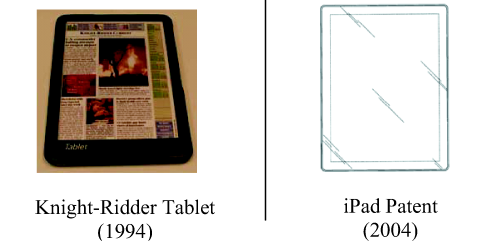
After Koh stated her inclination, Apple’s lead attorney tried to dissuade her from making, what he deemed, such a “surprising” finding final. While he made some cogent and legitimate arguments, he may have missed a critical point, namely, that the oblique surface shading lines in the iPad Patent were used specifically to limit the D'889 patent to cover only those tablets that have a flat front face entirely of glass.
The 1994 Knight-Ridder tablet, in contrast, does not have a front face that is covered entirely with glass. Moreover, not only does it not cover entirely with glass, the front face of the 1994 Knight-Ridder has an inset screen and is thus not flat like the front face of the D'889 patent.
While I am admittedly playing armchair quarterback, Apple’s counsel could have argued that visually speaking, these collective differences yield a very different overall appearance, and thus the D'889 patent’s validity should be sustained. In other words, Apple purposefully limited its D'889 and it should not now be invalidated by prior art that includes the very aspects that were excluded.
C. Samsung’s Novelty and Obvious Arguments Vis-à-Vis the iPhone Design Patents Center on Three Japanese Prior Art References
With respect to its challenges at the hearing to the validity of the iPhone design patents, Samsung relied exclusively on three prior art Japanese design patents (two owned by Sharp Corp. and the other by Fuji Film).
I have set forth the prior art references below, along with the Apple iPhone design patents.
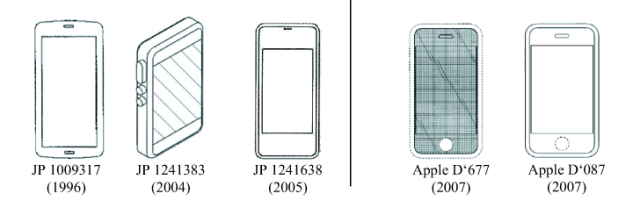
Unlike with the D'889 patent, Koh did not indicate during the hearing whether she believed that the iPhone design patents were invalid.
Circling back to my comments on the multiple embodiments, it appears that there is a potential soft spot in the validity of the D'087 patent. Specifically, Embodiment 2 of the D'087 patent (shown on the right below) claims the outer screen border, but disclaims both the speaker and the home button.
It is effectively a very broad embodiment. As a result, it may very likely be held to be anticipated by any of the Japanese prior art references.
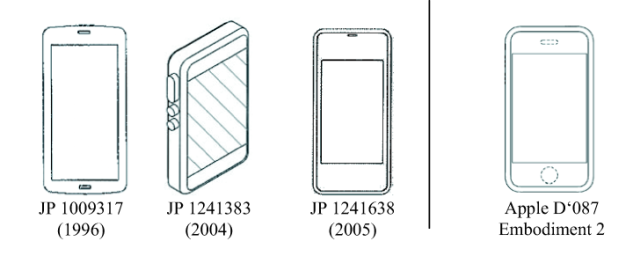
Given the claim scope that Koh used in her analysis of infringement and validity with respect to the iPad patent, she may likely deny the motion for preliminary injunction vis-à-vis the D'087 patent in view of potential validity issues posed by these Japanese references and Embodiment 2.
With respect to the D'677 patent, Apple may have similar issues.
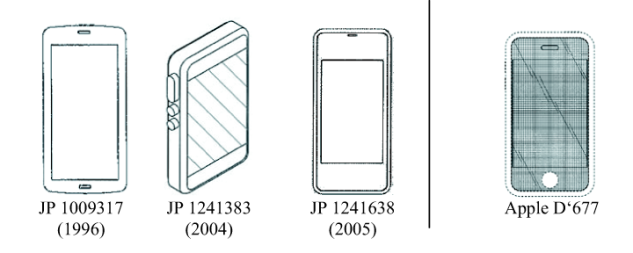
While none of the Japanese references disclose a black top surface or the precise positioning and shape of the speaker and screen, it will be interesting to see if these differences are enough to preserve the validity of the D'677 patent. See In re Iknayan,
Here again, given the claim scope that Koh used in her analysis of infringement and validity with respect to the iPad patent, she may likely deny the motion for preliminary injunction vis-à-vis the D'677 patent in view of potential validity issues posed by these Japanese references.
D. Samsung’s Functional Feature Argument: Judge Koh Please Don’t Take the Bait
At the hearing, Samsung’s counsel argued that all of the asserted Apple design patents are “invalid” because each element of the iPhone Design Patent is allegedly “functional,” and not “ornamental.”
We’re going to say that all of the elements are functional, so when you add them all up, you get a functional totality of the circumstance. But let’s go through them one by one.
(Tr. at 44-45.)Samsung’s counsel went on to argue, for example, that the devices’ surface is flat because it is easier to clean, the corners are rounded to prevent snagging, the shape is rectangular to be compatible with modern media, the speaker slot is positioned and shaped to allow the user to listen, etc. Samsung’s counsel concluded that because each element is “functional,” the entire design is functional, and thus invalid.
While this “divide-and-conquer” functionality-invalidity argument may have some initial shelf appeal, the Federal Circuit long ago made clear that this approach is not appropriate:
… the utility of each of the various elements that comprise the design is not the relevant inquiry with respect to a design patent. In determining whether a design is primarily functional or primarily ornamental the claimed design is viewed in its entirety, for the ultimate question is not the functional or decorative aspect of each separate feature, but the overall appearance of the article, in determining whether the claimed design is dictated by the utilitarian purpose of the article.
L.A. Gear Inc. v. Thom McAn Shoe Co., Samsung’s counsel also weaved in its functionality arguments into claim construction arguing that “functional” features should be ignored, citing Richardson v. Stanley Works Inc.,
For further discussion on the flaws of the masking tape approach, the reader is referred to the American Intellectual Property Law Association’s amicus brief in Richardson.
In short, like the now defunct “point of novelty” approach (which sought to separate out new and old elements), Samsung’s approach (which seeks to separate out ornamental and functional elements) conflicts with the tenet that a design patent protects the overall appearance of the claimed design. Samsung’s argument is akin to arguing that because each part of a Ferrari has a “function” (i.e., door for ingress/egress, headlights for night driving, windows for viewing, etc.), Ferrari cannot protect the overall appearance of its car design with a design patent.
Samsung’s argument misses the point that a product and its parts can have “function” but still be designed in many different ways. Indeed, the shear wealth of prior art in the cellphone industry produced by Samsung in this case belies any argument that the designs of the Apple iPhone design patents are somehow dictated by their function.
While, yes, the freedom of the designer may be somewhat restrained, there are still myriad alternative designs. In any event, Samsung’s arguments raise disputed fact questions (i.e., are there alternative designs?) that are for the fact finder, not Koh.
Lastly, Samsung should be careful what it asks for: if either its (1) “divide-and-conquer” functionality-invalidity argument or (2) “masking tape” claim construction arguments were accepted, it would set in motion a mass genocide of Samsung’s many U.S. design patents.
Indeed, according to PTO statistics, for the five-year period ending Dec. 31, 2010, Samsung was granted approximately 2,500 design patents, which was the most of any applicant during that time period and more than double the amount of grants to the second most active design patentee, Sony Corp.
III. Final Thoughts, Insights and Predictions
Typically, design patent cases have been won or lost on the issue of infringement, not on the issue of validity or invalidity. Even at the PTO, it is rare for a design patent applicant to receive a prior art-based rejection. Indeed, Professor Dennis Crouch on his Patently-O blog conducted a study showing that only 1.2 percent of design patent applications ever receive a prior art based rejection. http://www.patentlyo.com/patent/2010/01/design-patent-rejections.html. Much of this stems from the fact that it is very difficult to conclude, as a matter of design (not function), that a particular design is obvious in view of the prior art.
As an example of how difficult it is to invalidate a design patent under current design patent jurisprudence one should consider Vanguard Identification Systems v. Kappos, 407 Fed. Appx. 479 (Fed. Cir. 2011), where the Federal Circuit recently upheld the validity of a design patent in view of (by any estimation) close prior art. Images of the asserted prior art (left) and claimed design (right) are set forth below:
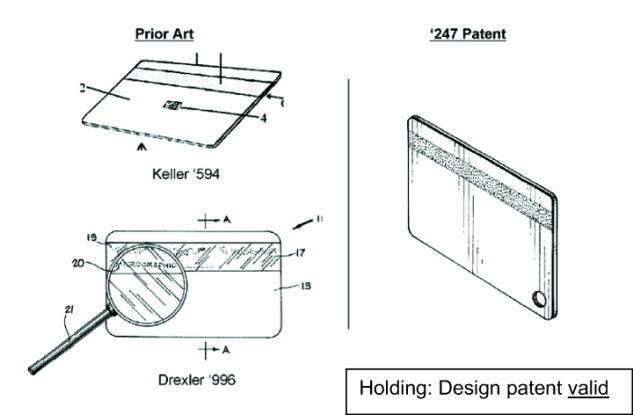
For more discussion on the Vanguard, the reader is directed to “Actions Speak Louder Than Words: Design Patents Get a Helping Hand From Federal Circuit—Vanguard v. Kappos” (
While the PTO may be employing a stringent standard to novelty, in 2009, a panel decision from the Federal Circuit significantly liberalized the test for anticipation. See International Seaway Trading Corp. v. Walgreens Corp ,
In other words, for anticipation, the test is the ordinary observer test in reverse. However, prior to Int’l Seaway, the Federal Circuit had required an anticipatory reference to be “identical in all material respects.” See Hupp v. Siroflex of America Inc.,
Significantly, the Int’l Seaway decision was not an en banc decision (which is necessary to overrule prior Federal Circuit precedent). Indeed, the Int’l Seaway court did not even cite Hupp or any of its precedent which established the “identical in all material respect” standard.
If Apple ultimately loses on any anticipation grounds based on the lower standard set forth in Int’l Seaway, it will be interesting to see whether Apple contests the precedential legitimacy of the Int’l Seaway holding.
As for the motion for preliminary injunction, based on her comments on the record regarding infringement and validity with respect to the iPad, Koh appears to be assigning a broad scope of coverage to design patents. While this is good for Apple’s infringement case (i.e., Samsung’s accused products would likely be held to fall within the scope of Apple’s design patents), such a broad scope does not bode well for Apple’s task of showing no substantial question of validity for its design patents.
Thus, inasmuch as (1) the court appears to be assigning a broad scope to the Apple design patents in view of its preliminary “thoughts” on infringement, and (2) Samsung has presented some relatively close prior art, it appears that Koh may likely find that Apple has not met its burden on validity at this stage of the case and deny the motion for preliminary injunction with respect to all patents.
I should add that I make my observations based upon the available public record. There are several documents in the case that remain under seal.
Finally, given the many issues that are implicated in this dispute, one can readily see that effective design patent prosecution and litigation strategies require a learned and thoughtful approach and deft navigation of the murky realm of design patent jurisprudence. While much is uncertain in this dispute, the world will be certainly watching (on their smart phones and tablets) as this case unfolds.
Learn more about Bloomberg Law or Log In to keep reading:
See Breaking News in Context
Bloomberg Law provides trusted coverage of current events enhanced with legal analysis.
Already a subscriber?
Log in to keep reading or access research tools and resources.