


In private company mergers and acquisitions (“M&A”) transactions, the definitive purchase agreement (whether asset purchase agreement, stock purchase agreement or merger agreement) usually includes representations, warranties, covenants and indemnities that survive the closing of the transaction. The purchase agreement also typically includes various provisions that impact the manner in which claims arising in connection with the transaction are to be dealt with, including those relating to choice of law, choice of venue, alternative dispute resolution, and waivers of jury trials. This article examines the use of jury trial waiver provisions in private company M&A transactions and trends in that usage as reported by American Bar Association (ABA) studies.
The Seventh Amendment of the Constitution guarantees the right to a jury trial for civil litigants in federal court. Most waivers of constitutional rights at the federal level must be knowing, voluntary and intelligent.
As the name suggests, a jury trial waiver in an M&A agreement means that the parties agree to waive—before any dispute arises—their rights to a jury trial in any dispute arising out of the M&A agreement and, depending upon the scope of the waiver provision, under other documents related to the M&A transaction. Were a dispute to occur, the judge would determine the outcome of the case.
In terms of enforcing the waiver, courts have split on the issue of determining which party bears the burden of proving the waiver was entered into “knowingly, voluntarily and intelligently.” Some district courts have placed the burden of proof on the party seeking enforcement,
A typical jury trial waiver provision could read as follows:
“Each of the Parties hereby waives, to the fullest extent permitted by law, any right to trial by jury of any claim, demand, action, or cause of action (a) arising under this Agreement or (b) in any way connected with or related or incidental to the dealings of the Parties in respect of this Agreement or any of the transactions related hereto, in each case whether now existing or hereafter arising, and whether in contract, tort, equity, or otherwise. Each of the Parties hereby agrees and consents that any such claim, demand, action, or cause of action shall be decided by court trial without a jury and that the Parties may file an original counterpart of a copy of this Agreement with any court as written evidence of the consent of the Parties to the waiver of their right to trial by jury.”
Arguments for a Jury Trial Waiver.
In a negotiation, the arguments for requesting a jury trial waiver provision may take the form of one or more of the following:
1. Jury trials are more costly and time-consuming than bench trials. Procedural requirements like voir dire and the submission of jury instructions, which can take weeks of preparation, can be avoided with a waiver provision.
2. Juries are viewed as being more likely to express their sympathy for individuals or smaller “mom-and-pop” institutions litigating against larger institutions. Judges are perceived to be better equipped at focusing on intricate legalities, leaving prejudices and biases out of the verdict.
3. Jury trials are viewed as producing more reversible verdicts due to error than bench trials. This can be due to juries’ perceived propensity to award excessive damages, faults in voir dire or jury instructions, or breaches in the heightened evidentiary standards of a jury trial.
Arguments Against a Jury Trial Waiver.
In a negotiation, the arguments for resisting a jury trial waiver provision may take the form of one or more of the following:
1. The right to a jury trial has been recognized for centuries as a very important aspect of our judicial system. Why should any party be asked to waive such an important right?
2. A jury trial waiver may be unenforceable within the jurisdiction chosen by the parties. Although a choice-of-law clause may be added to the agreement whereby the transaction will be governed by the laws of a state that enforces a jury trial waiver provision, courts may invalidate the choice-of-law if neither the parties nor the transaction has a sufficient relationship with that state.
3. As discussed above, there is potential for the jury trial waiver provision itself to be the subject of litigation, were a party to claim that the waiver was entered into involuntarily or unknowingly.
Trends in Usage of Jury Trial Waiver Provisions.
In 2005, 2007, 2009, 2011 and 2013, the American Bar Association released its Private Target Mergers and Acquisitions Deal Points Studies. These studies looked at the M&A agreements of transactions that occurred in the year prior to each study. In each year, the studies reviewed 128, 143, 106, 100 and 136 private company transactions, respectively. These transactions ranged in size from $17 million to $4.7 billion, across a broad range of industry sectors.
Over the past four studies,
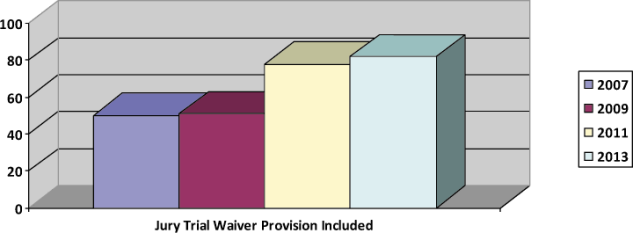
As is evident from the chart above, jury trial waivers have become an increasingly common provision in M&A agreements over the course of the last several years.
Conclusion.
Assuming that the ABA studies reasonably reflect general practice in private company M&A transactions, it appears that jury trial waiver provisions are often used in M&A agreements and have become even more common over the study period.
Determining whether or not to include a jury trial waiver is an important consideration in the overall M&A negotiation. That choice may well have a material impact on the outcome of post-closing claims between the parties. Counsel on both sides of an M&A transaction should consider these issues carefully when negotiating an M&A agreement.
Learn more about Bloomberg Law or Log In to keep reading:
See Breaking News in Context
Bloomberg Law provides trusted coverage of current events enhanced with legal analysis.
Already a subscriber?
Log in to keep reading or access research tools and resources.