


Making the Environment Count: A Bureau of Environmental Statistics
A new administration signals the return of that great national pastime: environmental enforcement numerology.
Responding to a Wall Street Journal story titled “EPA Makes Polluters Pay Less,”
What the article did not note was that Giles quote could have been lifted directly from a compelling internal White Paper she authored for the Environmental Protection Agency in June 1997, “Aiming Before We Shoot: A Revolution in Environmental Enforcement.”
Instead, we continue to receive reports and rhetoric that tell us next to nothing about the meaning of these numbers in relation to the question of how the broad goal of environmental protection is being served by public expenditures on environmental enforcement. In a time of limited federal budget dollars, Giles’s paper in effect asks, how should EPA spend its next dollar in the effort to obtain environmental compliance?
This obstacle to effective management of compliance resources also impedes the ability to have meaningful discussions or debates about the future of environmental regulation and enforcement. This becomes all the more critical as new measures, such as EPA’s new Greenhouse Gas Reporting Rule, go into effect,
Readers of this space over the past several years have been subjected to a consistent complaint about enforcement metrics. These critiques, and the failure to engage in Giles’ approach, are underlined by past reports by EPA’s own Inspector General. These reports illuminate the agency’s failure to develop adequate information regarding the regulated community or to make effective use of the data it has. Ten years after Giles’ article, EPA lacks “current and complete data on either the regulated entities or changes in their compliance status.”
of the Inspector General, U.S. Envt’l Prot. Agency
, Report No. 2007-P-000027: Overcoming Obstacles to Measuring Compliance: Practices in Selected Federal Agencies 1 (2007).
, Report No. 2005-P-00024: Limited Knowledge of the Universe of Regulated Entities Impedes EPA’s Ability to Demonstrate Changes in Regulatory Compliance (2005). Understandably, EPA objected to portions of the OIG report on the grounds that the recommendations propounded by the OIG failed to take into account the “significant resource commitments” necessary for implementation of improved information gathering. The OIG accepted that resources are a constraint, but noted that “it is fundamental for [EPA] to have an adequate range of knowledge about the entities it regulates,” and urged EPA to find the “best possible procedures” to do so. Id. at 42. It is notable that the corporate giant Wal-Mart employs approximately 75,000 people in its Logistics and Information Systems Division. It seems logical that data “fit for use” regarding the annual amount of contaminants discharged into the air, or sediments into the water, is as important as Wal-Mart’s knowledge that when Hurricane Ivan headed for the Florida panhandle, there would be a rise in demand for Pop-Tarts. See T. Herzog, F. Scheuren, W. Winkler, Data Quality and Record Linkage Techniques, Springer Science+Business Media
7, 18 (2007).
Drawing on Giles’ analysis, it is proposed that the federal government emulate the development of the Bureau of Labor Statistics and establish a Bureau of Environmental Statistics (BES). Such an entity could help improve environmental protection, grapple with developing data needs on climate change, and provide both the public and private sectors of the United States with reliable and comprehensive data about environmental matters.
The BES would be the principal fact-finding agency in the area of the environment It would be an independent national statistical agency, not an “office” of EPA or of any other federal agency. It would collect, process, analyze, and disseminate information to EPA and other federal agencies, as well as to the public, Congress, state and local governments, and the private sector. Like the Bureau of Labor Statistics, the value of the BES would stem from an ability to provide information that is accurate, impartial, timely, and relevant. BES data would similarly have to satisfy a number of criteria, including relevance to current environmental, social and economic issues, timeliness in reflecting today’s rapidly changing conditions, accuracy, and consistently high statistical quality, as well as impartiality in both subject matter and presentation.
The director of this new bureau should be someone who is impartial, knowledgeable, and strictly non-partisan. There is a ready model for such a person. In 1885, President Chester A. Arthur appointed Carroll D. Wright as the first director of the Bureau of Labor (as the Bureau of Labor Statistics was first called).
:
Bulletin 2234, at 3 (Sept. 1985).
: Volume 1, 48C 570-571 (1885).
Obama (Year One) v. Bush (2005 – 2008)
As could be predicted, the data available on the George W. Bush and Obama administrations provides little insight into the impact or value of environmental enforcement under either administration. While the numbers may satisfy the statistically illiterate harpoon wielders, they fail to illuminate the broader picture of environmental compliance.
Notably, there is a significant lag time between initial investigation of a case and litigation, which skews administration-specific statistics. Many of the court cases filed in 2009 were most likely opened by an EPA investigation during the tail end of the Bush administration. The same goes for verdicts and sentencing. For example, the largest fine ever assessed against a corporation for violations of the Clean Air Act, $50 million, was approved by a district court in 2009. The plea, however, was entered in 2007 and the case filing arose out of an investigation that began in 2005.
Criminal environmental enforcement is, ultimately, not usefully defined by convictions per year or the size of penalties. Indeed, given the relatively small overall number of environmental enforcement actions (civil and criminal), the yearly variations in the number of criminal convictions and penalties tend to fall well within a normal standard deviation.
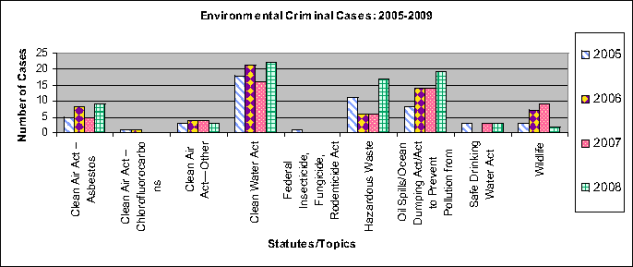
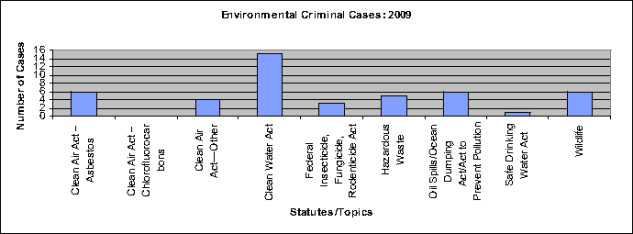
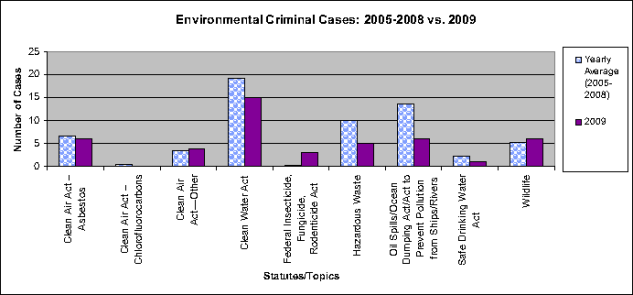
That being said, here’s what we found. The investigation of environmental violations grew during the first year of the new administration. During the George W. Bush years, both the number of EPA criminal investigators and the number of criminal cases EPA initiated or referred to the Justice Department for prosecution declined.
Like other sources, our data on environmental criminal cases is likely incomplete. Our sources, among others, include the websites of EPA and DOJ, as well as BNA’s Daily Environment Report, and the always useful Environmental Crimes Blog of Walter James, accessible at http://www.environmentalblog.typepad.com.
Presidential Appointments at EPA and DOJ
On May 7, 2009, the Senate confirmed three nominations for assistant administrator positions at EPA,
Upon arrival in office, the new assistant administrator made clear her intention to hire additional criminal investigators.
On February 1, 2010, Nancy Stoner joined EPA as the deputy assistant administrator for water. Stoner previously served at DOJ and in OECA’s Office of Planning and Policy Analysis from 1997 to 1999. She then left EPA to work for the Natural Resources Defense Council as a project director and attorney for NRDC’s Clean Water Project, and eventually as the co-director of NRDC’s Water Program.
On November 5, 2009, Ignacia S. Moreno was confirmed by the Senate as the 33rd Assistant Attorney General for the Department of Justice’s Environment and Natural Resources Division (ENRD). Ms. Moreno has practiced environmental law in both the private and public sectors, notably serving under the Clinton administration as special assistant (1994-1995), counsel, and then principal counsel to the assistant attorney general for environment and natural resources (1995-2001).
On March 5, 2009, Moreno announced her senior leadership, which includes Robert Dreher, principal deputy assistant attorney general, and deputy assistant attorney generals John Cruden, Ethan G. Shenkman, and Patrice Simms.
Dreher, a previous Sierra Club attorney and deputy general counsel of EPA, most recently served as the general counsel of Defenders of Wildlife and as the deputy executive director of the Georgetown Environmental Law & Policy Institute at Georgetown University Law Center. Dreher will oversee the Natural Resources and Wildlife and Marine Resources sections.
Cruden, a career deputy assistant attorney general, will oversee the Environmental Enforcement and Environmental Crimes sections.
Shenkman, who previously worked in both ENRD’s Appellate Section and the Law and Policy Section, returns to DOJ to oversee the Appellate and Indian Resources sections.
Simms, most recently a member of the law faculty at Howard University School of Law in Washington, D.C., will oversee the Land Acquisition and Environmental Defense sections.
2010 and Beyond
EPA National Enforcement Initiatives
Every three years, EPA selects national enforcement priorities on which to focus its resources. On January 4, 2009, EPA released for public comment the set of fifteen proposed priorities for fiscal year 2011–2013. See
- keeping raw sewage and contaminated stormwater out of waterways;
- preventing animal waste from Concentrated Animal Feeding Operations from contaminating surface and groundwater;
- cutting toxic air pollution that affects the health of communities;
- enforcing NSR and PSD Clean Air Act requirements at large industrial facilities;
- targeting toxic and hazardous waste generated by mining and mineral processing operations
- and assuring energy extraction sector compliance with environmental laws.
20 See U.S. Envt’l Prot. Agency, National Enforcement Priorities 2011-2013, http://www.epa.gov/oecaerth/data/planning/initiatives/initiatives.html.
EPA’s previous priorities for FY 2008-2010 cover the investigation of air toxics emissions and new source review compliance under the Clean Air Act; wet-weather discharges under the Clean Water Act; the compliance of mineral processors with Resource Conservation and Recovery Act; assuring financial responsibility of regulated entities under the Resource Conservation and Recovery Act and the Comprehensive Environmental Response and Liability Act; environmental issues in Indian country; and Concentrated Animal Feeding Operations (CAFOs).
EPA has set fewer priorities for 2011-2013 in order to focus more enforcement attention on each priority. Cynthia Giles, the assistant EPA administrator for enforcement, explained that EPA has focused on “too many” priorities in past years, which may have prevented a larger reduction in overall environmental noncompliance by the agency.
Under its new enforcement initiatives, EPA will place a new focus on coal, natural gas, and petroleum operations to promote the proliferation of “clean energy,” and will continue to focus on reducing discharges of raw sewage and contaminated stormwater from combined sewer overflows, with particular attention focused on older urban areas with aging sewer systems not designed to meet the demands of increased population. The agency will increase enforcement against large and medium-size CAFOs that continue to operate without required discharge permits for run-off laden with animal-waste entering surrounding surface waters.
EPA will also focus on excess emissions caused by facility failures in order to comply with EPA’s leak detection, repair requirements, and restrictions on flaring, as well as excess emissions released during start-up, shutdown, and malfunction events. Renewed attention will be directed toward the New Source Review and Prevention of Significant Deterioration requirements of the Clean Air Act to ensure that regulated large facilities install state-of-the-art air pollution controls when they reconstruct or make “significant modifications” to existing facilities.
Finally, EPA will increase inspections of and compliance enforcement for mining and mineral processing facilities that pose serious human health and environmental threats, including exposure to asbestos and lead poisoning in children.
DOJ Issues New Discovery Guidance in Criminal Cases
In January 2010, then deputy attorney general, David Ogden, released new guidance on discovery in criminal prosecutions. The guidance did not purport to establish new disclosure obligations but rather to create a set of baseline procedures and best management practices for all U.S. Attorney’s offices and DOJ litigating sections that should reflect judicial precedent and local rules. The U.S. attorneys must all develop policies that address:
- the timing of disclosures;
- disclosure of reports of interview for testifying or non-testifying witnesses;
- provision of disclosure beyond the requirements of Fed.R.Crim.P 16 and 26.2; Brady v. Maryland,
373 U.S. 83 (1963); Giglio v. United States,405 U.S. 150 (1972);
- the scope of the “prosecution team” in national security cases or cases involving regulatory agencies, parallel proceedings, or task force investigations;
- storing and reviewing substantive, case-related communications such as email (E-Discovery issues);
- obtaining Giglio information from local law enforcement officers;
- disclosure questions related to trial preparation witness interviews;
- disclosure of agent notes; and
- maintaining a record of disclosures.
In particular, the guidance clarifies who is included in the “prosecution team,” from which prosecutors, in preparing for trial, must seek all exculpatory and impeachment information. This team includes the federal, state, and local law enforcement officers and other government officials, which are often multi-district, that participate in the investigation and prosecution of the criminal case. In complex parallel proceedings conducted by regulatory agencies, like EPA, prosecutors should consider whether relationships with other agencies are close enough to make them part of the prosecution team for discovery purposes.
As part of this effort, on January 15, 2010, DOJ announced the appointment of Andrew Goldsmith as the new national coordinator for its criminal discovery initiatives. Goldsmith had been the first assistant chief of the Environmental Crimes Section at DOJ, and had previously been an Assistant U.S. Attorney for the District of New Jersey, the Chief of the Environmental Crimes Unit for the New York Attorney General’s Office, an Assistant District Attorney in the Manhattan District Attorney’s office and a private practitioner. Goldsmith’s new job will include oversight of DOJ’s efforts to provide training and resources to prosecutors to fulfill the discovery obligations set forth in the new guidance.
Not long before the issuance of the new guidance, in the well-known asbestos case, United States v. W.R. Grace, et al., No. CR 05-07-M-DWM (D. Mont. filed Apr. 28, 2009), the district court found that the government had not fulfilled its required disclosure obligations.
Increased Focus on Chemicals
In addition to the enforcement of current national priorities and new national enforcement initiatives, EPA is poised to ramp up its oversight of chemicals in 2010. In late 2009, the agency announced its commitment to strengthening the management of chemicals under the Toxic Substance and Control Act, while also recognizing the need for concerted TSCA legislative reform on the part of Congress.
Electronic Waste (“E-Waste”)
As the electronics used by U.S. society continue to age and as new models are introduced, the frequent disposal of unwanted or antiquated electrics is an increasing concern. If improperly disposed of, these electronic devices can leach toxic heavy metals into the surrounding environment such as lead, mercury, cadmium, and beryllium as well as hazardous chemicals, such as brominated flame-retardants, which are added to plastics to reduce fire damage.
In recognition of this emerging issue, in late 2009, EPA joined Interpol’s e-waste project, chaired by the U.K. Environment Agency, which coordinates multinational strategy for the investigation and prosecution of e-waste traffickers.
Cases of Note
* * *
Clean Air Act—Asbestos
United States v. Cease, No. 09 CR 878 (N.D. Ill. filed Oct. 26, 2009)—A City of Chicago environmental compliance inspector, Michael Cease, was charged with accepting two cash bribes totaling $1,150 for helping a landlord avoid enforcement under the city’s asbestos abatement ordinance. Allegedly, Cease informed the local landlord, as part of an environmental inspection, that both pipe insulation and floor tiles within the building contained asbestos, and for $600 Cease would provide a fake construction document stating the asbestos had been removed. According to the landlord, Cease later demanded an additional bribe to cover up the asbestos violations. The landlord secretly recorded Cease’s phones calls and in-person meetings and later contacted Chicago’s Office of Inspector General and the Federal Bureau of Investigation. Cease faces up to 10 years in prison and a fine of up to $25,000.
United States v. Fillers, No. 1:09-cr-147 (E.D. Tenn. plea entered Sept. 30, 2009)—The co-owner of the Tennessee-based salvage and demolition company, Watkins Street Project LLC (“Watkins Street”), pleaded guilty to asbestos handling and notification requirement violations relating to a scheme that placed workers at risk of asbestos exposure. Gary Fillers and other individuals formed Watkins Street to acquire, demolish, and salvage a textile plant in Chattanooga, TN, that contained substantial amounts of asbestos, which is regulated under the Clean Air Act’s national emissions standards for hazardous air pollutants (“NESHAPs”). Fillers and his “co-conspirators” agreed to demolish the plant without properly or completely removing the asbestos it contained. The conspirators hired untrained, unlicensed day laborers and homeless people to handle and remove the asbestos without proper protective equipment in violation of worker protection standards under the Clean Air Act. Fillers faces up to five years in prison and a fine of up to $250,000, or twice the gross gain or loss to victims of the conspiracy scheme.
United States v. San Diego Gas & Electric Co., No. 06-cr-65 (S.D. Cal. status conference held Sept. 11, 2009); 66 ERC 1742 (S.D. Cal. 2007); No. 08-50072 (9th Cir. Mar. 17, 2009)—In 2007, the California firm San Diego Gas & Electric was tried and found guilty on three counts of violating asbestos work practices under the Clean Air Act. The Judge granted a retrial in the case, ruling that pipe-wrap provided as evidence by federal prosecutors was incorrectly collected, documented, and tested. According to the judge, the 27 small samples of pipe-wrap taken from 9 miles of pipe-wrap did not accurately represent the presence or content of asbestos, which must be present at more than 1 percent for EPA to regulate the material. The samples have been ruled inadmissible evidence in the retrial as well.
United States v. Starnes, No. 07-3341 (3rd Cir. Sept. 24, 2009); United States v. George, No. 08-1691 (3rd Cir. Sept. 24, 2009)—The Third Circuit affirmed the convictions of Cleve-Allan George and Dylan C. Starnes for violations of asbestos work practices under the Clean Air Act and for the transmission of falsified air-monitoring reports in violation of
United States v. Wood, No. 1:06-cr-00494-DNH (N.D.N.Y. sentencing Feb. 11, 2009)—John Wood, operator of J & W Construction, Inc., a New York asbestos abatement company, and his employee Curtis Collins, were sentenced for illegal asbestos removal in violation of the Clean Air Act. Wood was sentenced to serve four years in prison and Collins was sentenced to two years in prison. Wood also paid $854,166.06 in restitution to victims of the illegal removal. Wood directed his employees to perform “rip and run” asbestos removals that left significant amounts of asbestos behind, which dispersed and contaminated many businesses and homes. Wood, with the help of a licensed air monitor, falsified air samples, leading clients to believe that all asbestos had been removed and that it was safe to return to their homes and businesses.
United States v. W.R. Grace & Co., No. CR 05-07-M-DWM-07 (D. Mont. June 16, 2009)— In June 2009, a federal judge dismissed the last remaining defendant, Mario Favorito, in the case against W.R. Grace and its former executives on charges of conspiracy, obstruction of justice, and criminal violations of the Clean Air Act. In May 2009, the company and three of its other executives were found not guilty by a jury on all counts that W.R. Grace knowingly endangered residents of Libby, Montana with tremolite asbestos contamination from their vermiculite mine and with obstruction of an EPA investigation into the contamination. Under the Clean Air Act, W.R. Grace was required to alert EPA of the dangers of the vermiculite mine shown by internal studies, but the company failed to do so. Defense attorneys argued that negligence on the part of EPA also played a significant role in the risk to the town because EPA was aware of the asbestos contamination, knowingly allowed it to continue, and failed to inform residents that the town had been declared an emergency site. The defense also presented the actions of W.R. Grace Executive Elwood Wood, who crafted and carried out a well-documented plan to clean up the mine that began in 1977.
Clean Air Act
United States v. Atlantic States Cast Iron Pipe Co., No. 3:03-cr-852 (D. N.J. Apr. 24, 2009)—Atlantic States Cast Iron Pipe Co. a subsidiary of McWane, Inc., one of the largest manufactures of ductile iron pipe, was fined $8 million for violations of environmental and worker safety laws, and four of the companies managers were sentenced on charges that they conspired to pollute the air and the Delaware River over an eight-year period. The company was convicted of allowing high level emissions of pollutants, including carbon monoxide, and of concealing the releases, in violation of the Clean Air Act. The company pumped petroleum-contaminated wastewater into a storm drain in 1999, creating an eight and a half mile oil slick on the Delaware River, in violation of the Clean Air Act. The company was also convicted of covering up a number of work related accidents at its New Jersey facility. In addition to the fines the company must undergo four years of monitoring and provide a bi-annual progress reports to the court of its compliance with the Clean Air Act and Clean Water Act.
United States v. BP Products North America Inc., No. 07-cr-434 (S.D. Tex. plea approved Mar. 12, 2009); United States v. BP Products North America Inc., No. 2:96-cv-95 (N.D. Ind. February 19, 2009)—BP Products North America Inc. agreed to pay a $50 million criminal fine pursuant to a plea agreement under the Clean Air Act in connection with an explosion at the company’s refinery in Texas City, Texas, which killed 15 employees. The penalty is the largest criminal fine ever assessed against a corporation for Clean Air Act violations and is in addition to three years probation. In a separate case, BP also agreed to pay $180 million to settle a civil suit stemming from the violations at the Texas City location. In that case, BP failed to comply with a consent decree to undertake strict controls on benzene and benzene-containing wastes produced in the refinery’s operations. Of the $180 million settlement, at least $161 million will go to pollution controls, enhanced maintenance and monitoring, and improved internal management practices at the refinery. $12 million of the settlement is a civil penalty and $6 million will support an environmental project to reduce air pollution in the Texas City community.
United States v. Franco, No. 2:10-cr-00006-RLH-PAL-1 (D. Nev. indictment Jan. 1, 2010) (each defendant was charged individually in separate cases)— Ten Nevada-certified emissions testers were each charged with one felony violation of the Clean Air Act for falsifying vehicle emissions test reports. The alleged falsifications numbered between 250 to over 700 for each individual defendant. The defendants engaged in what is termed “clean scanning,” which involves the substitution of an emission compliant vehicle during the testing of a vehicle, which would not pass an emissions inspection. The non-compliant vehicle number is entered into the testing system, while the compliant vehicle is actually tested, resulting in a fraudulent pass. The defendants each face up to two years in prison and a fine of up to $250,000.
United States v. Gordon-Smith et al., No. 6:08-cr-06019-CJS-2 (W.D.N.Y. second superseding indictment Oct. 22, 2009)— David Vega and Francis Rowe, two former project managers for Gordon-Smith Contracting, an asbestos removal company owned by Keith Gordon-Smith, were charged in a superseding indictment with violations of the Clean Air Act. The original indictment charged the individual owner of the company, Keith Gordon-Smith, with violations of the Clean Air Act, including submitting false statements and obstruction of justice. The superseding indictment additionally charges Gordon-Smith’s company with the same criminal violations and also charges Rowe individually with submitting a false statement in order to obtain a court-appointed attorney. The violations occurred during the demolition of Genesee Hospital in Rochester, New York, when Keith Gordon-Smith, Gordon-Smith Contracting, Vega, and Rowe allegedly directed and caused workers to illegally handle, remove, and dispose of asbestos. The 18-count indictment charges that the defendants removed the asbestos without following proper procedures, directed illegal asbestos removal at other sites, and hid the illegal asbestos removal from federal agencies. Concealing these activities involved failing to provide prior notification to EPA before removal at schools and hospitals, giving false statements to an Occupational Safety and Health inspector, and providing false notification to EPA. The three individuals could each face up to five years in prison and a fine of up to $250,000 for each count. Gordon-Smith Contracting could be ordered to pay a fine for each count of the greater of $500,000 or twice the gain obtained by the company or suffered by any victims as a result of the crimes.
United States v. Shore Terminals, LLC, No. CR 09-395 SI (N.D. Cal. July 14, 2009)—A three-year investigation by EPA and the Bay Area Air Quality Management District of the tank farm Shore Terminals LLC (“Shore Terminals”) resulted in a plea agreement pursuant to which the company must pay $1.75 million in fines and $750,000 in future air quality projects in the California counties of Contra Costa and Alameda. In July 2009, Shore Terminals LLC pleaded guilty to four felony counts of making false statements to government officials in violation of Title
Clean Water Act
United States v. Atlantic Wire, No. 3:08-cr-00266 (D. Conn. Dec. 30, 2008)—A Connecticut manufacturer of steel wire and processed rod pleaded guilty to two counts under the Clean Water Act and one count of submitting false statements to the Connecticut Department of Environmental Protection. In a separate civil settlement, the company agreed to pay $1.5 million to settle similar Clean Water Act violations. Both the criminal guilty plea and state civil penalty stem from a series of discharges of dirty water into the Branford River from the company’s Branford, Connecticut facility, where it manufactured steel wire and processed rod. The company shut down operations and filed for bankruptcy in 2009. The company has set aside $897,000 from its bankruptcy proceedings for cleanup activities at the Bradford River site and is nearing completion of the removal of equipment and chemicals stored at the site. The company still faces criminal sentencing.
People v. Rose, No. 09-46 (N.Y. County Ct. [Broome] indictment Feb. 27, 2009)—The former superintendent and a former employee of a drinking water filtration plant in Binghamton, New York were charged with knowingly discharging sludge into the Susquehanna River. The two men, Kevin E. Transue and Daniel E. Rose, allegedly discharged chemical-laden filtration sludge into the river between March 2006 and November 2007 in violation of the plant’s SPDES permit. Rose was charged with 14 felony counts of knowingly discharging pollutants into state waters, each of which carries a maximum penalty of four years in prison. Transue was charged as a knowing accomplice in seven of the felony counts and with three misdemeanor charges for failure to file annual reports pursuant to the SPDES permit. Each misdemeanor charge carries a maximum penalty of one year in prison.
United States v. Baggett, No. 4:09-CR-10025 (S.D. Fla. sentencing Oct. 14, 2009); No. 2:07-CR-619 (D. Utah transferred July 2, 2009)—Baggett Larkin, the owner and operator of Chemical Consultants Inc., a company that mixed and sold chemical products used in the trucking, construction, and concrete industries, was sentenced to five years in prison for felony violations of the Resource Conservation and Recovery Act and three years in prison for the felony violations of the Clean Water Act—the statutory maximum for charges under both Acts. In 2007, Baggett instructed his employees to dispose of industrial waste including sulfuric, hydrofluoric, and hydrochloric acids, as well as nonylphenol, an organic chemical toxic to aquatic life, by dumping them onto the ground and into a sanitary sewer drain, which flows into the Jordan River and eventually into Great Salt Lake.
United States v. Brusco Tug & Barge, Inc., No. CR -09-0728 SI (N.D. Cal. plea entered Sept. 11, 2009)—Brusco Tug & Barge, Inc. (“Brusco”), a maritime services corporation in Washington, pleaded guilty to one felony count of violating the Clean Water Act for the discharge of dredged material without a permit. The company was sentenced to pay $1.5 million, with $750,000 to be paid as a fine, and $250,000 to be paid to the National Fish & Wildlife Foundation to fund environmental projects relating to marine and coastal habitats and watersheds in the Bay Area. The remaining $500,000 will be used by the company to create and implement an Environmental Compliance Plan (“ECP”). The company was employed to tow barges containing dredge material to a privately owned island managed as a freshwater wetland and duck hunting club. Brusco was supposed to dispose of the dredge material on land for use in levee rehabilitation and maintenance, but often the company would often simply dump the dredge into the waters surrounding the island.
United States v. Case, No. 3:08-cr-77 (W.D.N.C. sentencing May 28, 2009)—The former operator of North Carolina municipal wastewater treatment plant, Dean Kirby, was sentenced to two months of home confinement, two years of supervised probation, 400 hours of community service, and a fine of $5,000 for violations of the Clean Water Act. Case pleaded guilty in June 2008 to the illegal discharge of pollutants from the treatment plant and to making false statements to the Department of Environment and Natural Resources regarding levels of toxic substances in the discharge. In April 2009, Case’s supervisor, George Wallace Hughes, was sentenced to one year supervised probation and a $1,000 fine. Case testified that Wallace instructed him to provide regulators with drinking water instead of wastewater treatment plant discharge samples.
United States v. Garvey, No. 4:09-CR-00023 (W.D. Mo. sentenc
ing Sept. 1, 2009)—William Garvey, president of HPI Products Inc. (“HPI”), a Missouri pesticide company, was sentenced to six months in prison, six months home confinement, and a fine of $100,000 discharging pesticide waste into the sewer system of St. Joseph, Missouri, in violation of the Clean Water Act. Garvey instructed employees at all three of HPI’s production facilities to wash spills, wastes and equipment rinses down floor drains connected to the city’s sewer system. Three other HPI production facilities were used to store pesticides and wastes, which were not inadequately maintained and which spilled and leaked into the soil surrounding the buildings. In a related case, HPI’s vice president faces up to 12 months in prison, and a fine of greater than $100,000 or the loss caused for failure to notify regulatory agencies of the illegal storage pesticides in the HPI production facilities and failure to maintain records of such storage in violation of the Federal Insecticide Fungicide and Rodenticide Act.
United States v. Gearin, No. 09-CR-64 (D. Or. filed Feb, 19, 2009); United States v. Port of Astoria, No. 09-CV-197 (D. Or. filed Feb. 19, 2009)—The former director of the Port of Astoria, Oregon, Peter Gearin, pleaded guilty to felony violations of the Clean Water Act for knowingly allowing the discharge of untested, contaminated overflow water in violation of a Section 404 dredge-and-fill permit issued by the U.S. Army Corp of Engineers to the Port for cruise slip dredging. Under the permit, dredged material and water was held in ponds, allowed to settle, and tested for contaminants before it was allowed to flow back into the Columbia River. In knowing violation of the permit, Gearin allowed dredge water to flow through the containment ponds and back into the river without any settling or sampling. Gearin faces up to three years in prison and a $50,000 fine for each day of violation. In a separate civil case, the Port of Astoria, Oregon agreed to pay $125,000 and to retain an environmental compliance officer to settle violations under the Clean Water Act stemming from the same discharges of water from dredging operations.
United States v. House of Raeford Farms, Inc. et al., No. 1:09-cr-00395-UA-2 (N.C. M.D. indictment Nov. 30, 2009)—House of Raeford Farms, Inc, a turkey processing plant, and Gregory Steenblock, its manager, were indicted on 14 counts of violating the Clean Water Act for discharging untreated wastewater from the plant. The defendants allegedly allowed plant employees to bypass the facility’s pretreatment system and send untreated wastewater, contaminated with blood and body parts from slaughtered poultry, into the city’s Publicly Owned Treatment Works. The bypasses violated the plant’s permit, the city’s sewer use ordinance, and the plant’s consent order with the city that required the elimination of all such bypasses. If convicted, the plant faces a maximum fine of $500,000 or twice the gain or loss resulting from the offense, whichever is greater, for each count. Steenblock faces a maximum penalty of five years in prison and a $250,000 fine for each count.
United States v. Pruett, No. 09-00112 (W.D. La. June 4, 2009)—Jeffrey Pruett and his public water and wastewater treatment companies, Louisiana Land & Water Co. and LWC Management Co., were indicted on 17 counts of violating the Clean Water Act for failing to property operate water and wastewater treatment facilities in seven residential subdivisions in Ouachita Parish, Louisiana. Pruett and his companies allegedly allowed a wastewater treatment facility to overflow into several different residential subdivisions, discharged effluent on the ground without proper tertiary treatment, allowed suspended solids and fecal coliform to exceed effluent limitations in state discharge permits, and discharged raw sewage into several residential neighborhoods.
United States v. Roto Rooter et al., No. 1:09-cr-00242-KD-C-3 (S.D. Ala. indictment Oct. 29, 2009)—The waste disposal company Roto Rooter, along with its president, Donald Gregory Smith, and its manager, William Wilmoth Sr., were indicted on 43 criminal counts including violations of the Clean Water Act and charges of fraud and conspiracy for dumping waste grease and oil into local sewers. The company was paid to remove grease waste and dispose it legally for local restaurants and other food service establishments as required by an EPA court order to collect grease and cooking oil in order to prevent it from entering Mobile’s sewer system. Instead, Roto Rooter allegedly dumped thousands of gallons of the waste grease and oil into Mobile’s sewer lines. Michael Edington, another Roto Rooter employee, previously pleaded guilty to dumping grease from Roto Rooter pump trucks into the city sewer systems and falsifying tracking information to conceal the dumping. In addition to monetary penalties, the defendants face up to three years in prison for each count under the Clean Water Act, and a maximum of 20 years of prison for fraud.
United States v. Sawyer, No. 5:08-CR-40045 (D. Kan. plea entered Feb. 24, 2009)—The owner of a fertilizer manufacturer in Lawrence, Kansas, Raymond Sawyer, pleaded guilty to the illegal discharge of manufacturing waste into the city’s sewer system and faces up to a maximum possible penalty of one year in prison and a fine of up to $25,000 per day of the violation. The company, MagnaGro International Inc., faces a possible fine of $50,000 or more per day of the violation. The company was discharging waste from fertilizer production into the sewer through a hose inserted into a toilet. The hose was used to pump material into the toilet from a waste pit surrounding a mixing vat. EPA investigators believe the discharges had been going on for at least 10 years.
United States v. Spain, No. 06CR0545 (N.D. Ill. sentencing Feb. 4, 2009)—James E. Spain, former president of Crown Chemical Inc. (“Crown”) of Crestwood, Illinois was sentenced to a $30,000 fine, 12 months of home confinement, and three years probation for the illegal dumping of acidic and caustic wastewater into a regional sewer system. Spain was charged with the illegal discharges, lying to federal investigators and conspiracy. Pursuant to his guilty plea, Spain admitted to directing employees to discharge untreated wastewater from company tanks into the sewers for 16 years, from 1985 until 2001. Crown, which manufacturers industrial and commercial home cleaning products, pleaded guilty to similar charges and was sentenced to pay a criminal fine of $100,000, serve one year probation, and was required to make a public apology. Crown’s manager was also charged for the illegal dumping and was sentenced to pay a fine of $5,000 and serve two years probation.
United States v. City and County of San Francisco, No. CV 09-5104 (N.D. Cal. settlement Nov. 2, 2009)— The San Francisco Municipal Transit Authority agreed to pay $250,000 pursuant to a settlement with EPA resolving environmental charges stemming from a 2005 diesel spill at a refueling facility in violation of the Clean Water Act and the Resource Conservation and Recovery Act. A faulty hose at the transit agency’s bus servicing facility allegedly ruptured and caused underground storage tanks to overflow, resulting in the release of 39,000 gallons of red dye diesel fuel into a storm drain, which caused problems at a wastewater treatment pump station. The diesel fuel also spilled into a creek that empties into the San Francisco Bay. After the spill, the city’s Municipal Transit Authority improved its facilities and procedures in order to prevent similar accidents.
United States v. Sturgeon, No. 2:08-CR-4032 (W.D. Mo. sentencing Aug. 25, 2009)—In early 2009, a former public works director for Lake Ozark, Missouri, Richard L. Sturgeon, was sentenced to three years probation and a $5,000 fine for failure to report discharges of raw sewage into a large resort lake in violation of the Clean Water Act. Sturgeon was aware of the City of Ozark’s repeated discharge of raw sewage into the Lake, a popular recreational destination, but failed to report the discharge in violation of the City’s SPDES permit. In a related case, the City pleaded guilty to discharge of raw sewage from several of its collection stations and was ordered to pay a $50,000 fine, upgrade its wastewater treatment system, and report all overflow events to the Missouri Department of Natural Resources. The prosecution of Sturgeon and the City is reportedly the first to stem from information received via EPA’s “Report an Environmental Violation” website. A concerned citizen used the system to report the discharge of 10,000 to 15,000 gallons of sewage into the Lake Ozark in 2007. Since this initial prosecution, EPA states that it has opened 19 criminal cases across the nation based on similar reports, two of which have proceeded to criminal prosecution.
United States v. McWane Inc., No. C.R. 04-PT-199-S (N.D. Ala. sentencing Dec. 18, 2009)—McWane Inc. (“McWane”), one of the largest cast iron manufacturers in the country, pleaded guilty to nine felony counts of violating the Clean Water Act for discharging thousands of gallons of industrial wastewater into a tributary of the Black Warrior River from 1999 to 2001. Pursuant to the plea agreement, McWane must pay a $4 million penalty, serve five years probation, and construct a park that includes a natural stormwater collection and treatment system. James Delk, the former general manager and vice president of McWane’s Birmingham plant, where the violations occurred, was sentenced to an $8,000 criminal fine and 36 months probation, and Michael Devine, the former manager of the McWane Cast Iron Pipe Co., was sentenced to a $2,000 criminal fine and 24 months probation. Under the terms of its NPDES permit, McWane was required to treat its wastewater, which included grease, oil, and zinc, before discharging it into Avondale Creek (which flows into a tributary of the Black Warrior River).
Federal Insecticide, Fungicide, and Rodenticide Act
United States v. Fresh King Inc., No. 1:08-cr-20416-UU (S.D. Fla. sentencing Apr. 9, 2009)— Fresh King Inc., a South Florida produce company, and its owner were sentenced to a $100,000 fine and $375,000 in criminal forfeiture for the importation of Guatemalan snow peas and sugar snap peas contaminated with the pesticides methamidophos and chlorothalonil. The company owner and president Denise Serge was also sentenced to three years of probation and nine months of house arrest. Her husband, Peter Schnebly, the company’s vice president, was sentenced to two years of probation.
United States v. Greenleaf LLC, No. 3:08-CR-05033 (W.D. Mo. sentencing Aug. 20, 2009)—A Missouri pesticide dealer, Greenleaf LLC, was fined $200,000, for reselling more than 2 million pounds of discarded and broken bags of pesticides and rodenticides, received from Wal-Mart stores. Greenleaf LLC, plead guilty to the charges after a previous agreement to pay $100,000 in settlement of a civil enforcement action filed by EPA in connection with the same resale. Both the criminal and civil actions arose from an inspection by the Missouri Department of Agriculture of Greenleaf’s facilities in Neosho, Missouri, which uncovered several violations, including distribution of unregistered pesticides, distribution of misbranded pesticides, the holding for distribution of pesticides with compositions different from those listed on their registration statements, and various recordkeeping violations. Greenleaf has ceased operations at its only two business locations, which are in Neosho and Pineville, Missouri.
United States v. Nielsen, No. 4:09-CR-00189 (W.D. Mo. plea entered Aug. 30, 2009)—Hans Nielsen, the vice president of HPI Products Inc. (“HPI”), a Missouri pesticide company, pleaded guilty to two counts of violating the Federal Insecticide, Fungicide and Rodenticide Act for failure to notify regulatory agencies of the illegal storage of pesticides by HPI and failure to maintain records of such storage. Nielson faces up to 12 months in prison, and a fine of the greater of $100,000 or the loss caused. In a related case, HPI’s president was sentenced to six months in jail, six months home confinement, and a $100,000 fine for the illegal discharge of pesticide wastes into the sewer system connected to the St. Joseph River, in violation of the Clean Water Act.
Hazardous Waste
State v. Elizabeth Mining and Development, No. 06-CV-250 (Colo. Dist. Ct. Mar. 4, 2009); State v. Ratner, No. 07-CR-128 (Colo. Dist. Ct. Apr. 23, 2007)—A Colorado District Court granted a preliminary injunction motion against a precious metals recovery business based on evidence that the practices of the business were “environmentally irresponsible and incompatible” with the state’s Hazardous Waste Act. The court ordered Elizabeth Mining and Development to determine the level and type of contamination present at the company’s facility in Montrose, Colorado and to implement all necessary cleanup. The company recycles platinum, palladium, and rhodium from catalytic converters at the site. A state inspection revealed that acids used in the recycling process were dumped directly onto the ground and hazardous waste storage and treatment tanks were inadequate. A February 2006 inspection identified violations of the state Act, and the company was ordered to cease all hazardous waste generating processes until the facility was brought into compliance. The company resumed operations without compliance and without permission from the Colorado Department of Public Health and Environment. Four company employees were indicted on charges of violating state hazardous waste law, organized crime laws, and securities fraud, while the company faces penalties of up to $420,000.
United States v. Hersh, No. 1:07-CR-60 (N.D. Ind. sentencing Feb. 2, 2009)—Alan Hersh, former president and owner of the barrel recycling plant Hassan Barrel Co. (“Hassan”), was sentenced to 15 months in prison and three years of supervised release for abandoning a seven-acre site in Fort Wayne, Indiana that contained leaking barrels of caustic chemicals and open pits filled hazardous waste. The hazardous material was stored on site until October 2003 when Hassan went out of business. Hersh was sentenced to pay $1.7 million in penalties and cleanup costs after pleading guilty to the knowing storage and disposal of hazardous waste, in violation of the Resource Conservation and Recovery Act.
United States v. Southern Union Co., No. 07-134-S (D.R.I. Oct. 2, 2008); United States v. Southern Union Co., No. 07-134 (D.R.I. July 12, 2009)—Southern Union Co. (“Southern”) was penalized $18 million and sentenced to two years probation, almost a year after it was found guilty of illegally storing mercury at a company-owned Rhode Island facility without a permit. The penalty consists of a $6 million criminal fine and a $12 million payment designated for various environmental remediation, education, and children’s health initiatives in the community. Earlier in the year, the U.S. District Court for the District of Rhode Island held that federal prosecutors could seek criminal convictions of companies for violating a state regulation requiring even small hazardous waste generators to obtain a storage permit. Southern moved for an acquittal, arguing that the state requirement impermissibly broadens the federal Resource Conservation and Recovery Act program. The court rejected Southern’s argument and upheld EPA’s earlier determination that the state regulation is simply more stringent than the federal program.
Oil Spills/Ocean Dumping/Act to Prevent Pollution From Ships
Alaska v. American West Steamboat Co., No. 1JU-09238CR (Alaska Super. Ct. sentencing Apr. 24, 2009)—In April 2009, the American West Steamboat Co., operator of the cruise ship Empress of the North, was sentenced to a $200,000 criminal fine, $150,000 of which will be suspended upon completion of an 18 month probation period without further violations. In May 2007, the cruise ship grounded in southeast Alaska near Glacier Bay Park and spilled an unknown amount of fuel oil into the ocean. A National Transportation and Safety Board investigation determined that the accident was due to an inexperienced and unqualified mate, who was assigned to watch when the ship was making a turn. The payment will be deposited into Alaska’s Oil and Hazardous Substance Release Prevention and Mitigation Account.
United States v. Consultores De Navegacion, No. 1:08-cr-10274 (D. Mass. s
entencing July 27, 2009); United States v. Oria, No. 08-10274 (D. Mass. plea entered Mar. 9, 2009)—Consultores De Navegacion, the Spanish-based operator of the chemical tanker M/T Nautilus was sentenced to pay $2.08 million and serve three years probation for conspiracy, falsification of records, false statements, obstruction, and two violations of the Act to Prevent Pollution from Ships for dumping of oil-contaminated bilge-waste and failure to maintain an accurate oil records book. The shipping company was also ordered to implement a comprehensive environmental plan to prevent future violations. The violations were uncovered by a 2008 U.S. Coast Guard inspection of the M/T Nautilus that revealed oil-contaminated bilge water was discharged through a metal pipe used to bypass the ship’s oil-water separator and dumped directly overboard. Crewmembers subsequently falsified the ship’s official oil record book to conceal their activities. Carmelo Oria, the chief engineer of the M/T Nautilus was sentenced to one month in prison, two years supervised release, and a $3,000 fine.
United States v. ExxonMobil Pipeline Co., No. 08-cr-10404 (D. Mass. Apr. 30, 2009)— ExxonMobil Pipeline Co., a subsidiary of ExxonMobil, was ordered to pay over $6.1 million in fines and community service contributions in connection with a January 2006 oil spill from its oil terminal in Everett, Massachusetts into the Mystic River. The spill resulted from a leak during the off-loading of petroleum products from the oil tanker M/V Nara, and released 2,500 gallons of kerosene and 12,700 gallons of low-sulfur diesel fuel into the river, which spread into the Boston Harbor. The company was also sentenced to three years probation and terminal monitoring by a court appointed observer.
United States v. Fleet Management Ltd., No. 08-0160 SI (N.D. Cal. Aug. 13, 2009)—Fleet Management Ltd., the Hong Kong-based operator of the ship Cosco Busan, agreed to pay $10 million under a plea agreement (approval pending), resolving criminal charges under the Oil Pollution Control Act of 1980, in connection with a November 7, 2007 oil spill that occurred after the ship struck a section of the San Francisco-Oakland Bay Bridge. Pursuant to the plea, Fleet Management admitted that its negligent actions were the proximate cause of the discharge of a harmful quantity of oil into the San Francisco Bay. The company also admitted that it concealed ship records and created false documents to influence the U.S. Coast Guard investigation of the spill. In related case, the Cosco Busan’s pilot was sentenced to 10 months in prison and 200 hours of community service after he pleaded guilty to negligently causing the discharge of 53,000 gallons of oil into the Bay and the subsequent death of 2,000 migratory birds. See also United States v. Cota below.
United States v. General Maritime Management (Portugal) LDA, No. 2:08-cr-393 (S.D. Tex. sentencing Mar. 13, 2009)—Portuguese tanker operator, General Maritime Management (Portugal) (“Genmar”), was sentenced in early 2009 to a $1 million fine and five years probation for discharging waste oil into the Gulf of Mexico. Five whistleblowers from the Genmar ship Defiance were awarded $250,000 for reporting the 2007 incident. Genmar and two of its employees were convicted of maintaining a false oil record book and presenting it to the U.S. Coast Guard. The Genmar employees, Jose Cavadas and Antonio Rodrigues, instructed crewmembers to bypass the ship’s oil-water separator and discharge oil-contaminated water directly into the Straits of Florida and the Gulf of Mexico. Rodrigues was sentenced to three months in a halfway house, a $500 fine, an assessment of $200, and five years probation. Cavadas was sentenced to six months in a halfway house, a $500 fine, an assessment of $200, and five years probation.
United States v. Holy House Shipping AB, No. 08-cr-782 (D. N.J. sentencing Mar. 10, 2009); United States v. Krajacic, No. 08-cr-824 (D. N.J. sentencing Dec. 16, 2008)—A Swedish shipping company pleaded guilty in October 2008 to failure to maintain an accurate oil record book and the use of false documents in connection with attempts to conceal illegal dumping of oil-contaminated wastewater from the ship M/V Snow Flower into the ocean off New Jersey. Two of the ship’s crewmembers reported that they were ordered to bypass the pollution-prevention equipment and discharge oil-contaminated waste directly into the ocean. Subsequently, a routine U.S. Coast Guard inspection revealed various discrepancies in the oil record book related to the capacity and use of the ship’s oil-water separator. The shipping company was sentenced to pay a $1 million fine, a $400,000 community service assessment, serve three years of probation, and implement an environmental management system and compliance program. The two whistleblowers were awarded $375,000. The chief engineer of the M/V Snow Flower, Igor Krajacic, pleaded guilty to failure to maintain an accurate record book and was sentenced to pay a $8,000 fine and serve one year probation.
United States v. Polembros Shipping Ltd., No. 09-252 (E.D. La. sentencing Dec. 9, 2009)—Polembros Shipping LTD. (“Polembros”), a ship management company headquartered in Greece, pleaded guilty to violations of the Act to Prevent Pollution from Ships for failure to maintain an accurate oil record book for the M/V Theotokos, which carried fuel oil in a tank forward of its collision barrier. The company also pleaded guilty to a violation of the Nonindigenous Aquatic Nuisance Prevention and Control Act for failure to maintain accurate ballast water records (the first conviction under the Act), and violations of the Ports of Waterways Safety Act for failure to report hazardous conditions related to a crack on the rudder stem of the ship, and for making false statements concealing a fuel oil leak into the forepeak ballast tank during a U.S. Coast Guard investigation. Polembros was sentenced to pay a $2.7 million criminal fine and three years probation, during which time all 20 ships owned or managed by Polembros are barred from entering U.S. ports and territorial waters. Polembros was also ordered to make a separate $100,000 community service payment to the Smithsonian Environmental Research Center. Nine former crewmembers of the M/V Theotokos were awarded a total of $540,000 for information that led to the conviction. The ship’s master, Panagiotis Lekkas, was sentenced to pay a $4,000 fine, ten months confinement, and a three year ban on entering U.S. ports and territorial waters. In a related case, Georgios Stamou was sentenced to pay a $15,000 fine and serve a term of probation that included a five-year ban on entering U.S. ports and territorial waters.
Wildlife
United States v. Calhoun, No. 2:09-mj-00019-DLH-1 (W.D. N.C. sentencing Jan. 13, 2010)—Clement Calhoun, a member of the Cherokee Nation, was sentenced to six months in prison after he pleaded guilty to federal charges of illegally transporting and selling 51 bear gall bladders. Bile from a bear’s gall bladder is a coveted ingredient in traditional Asian medicines and the increasing demand for these organs is believed to threaten the U.S. black bear population. From January through September 2005, Calhoun unlawfully trafficked the bear gall bladders from trust lands to sell them to non-members of the Cherokee Nation. The sales, totaling at least $6,600, violated both the federal Lacey Act as well as the Cherokee Code. The Lacey Act prohibits the transport or sale of wildlife, including animal parts, taken, possessed, transported, or sold in violation of tribal law. The Cherokee code prohibits the sale big game animal parts to non-members of the tribe, to anyone beyond the boundaries of Cherokee trust lands, or to anyone who will remove the parts from trust lands. Following his prison sentence, Calhoun will serve one year of supervised release and will be prohibited from hunting or possessing a hunting license.
United States v. Cota, No. 08-1060 SI (N.D. Cal. July 17, 2009)—The California harbor pilot of the shipping tanker Cosco Busan, John Cota, was sentenced to 10 months in prison and 200 hours of community service for his role in the ship’s oil spill and the subsequent death of migratory birds. In late 2007, the Cosco Busan struck a section of the San Francisco-Oakland Bay Bridge. See also United States v. Fleet Management Ltd. above. Cota pleaded guilty to negligently causing the discharge of oil and to causing the death of at least 2,000 migratory birds.
United States v. ExxonMobil Corp., No. 09-01097 (D. Colo. Aug. 12, 2009); No. 09-132 (W.D. Okla. Aug. 12, 2009); No. 09-10073 (D. Kan. Aug. 12, 2009); No. 09-172 (D. Wyo. Aug. 12, 2009); No. 09-042 (N.D. Tex. Aug. 12, 2009)—ExxonMobil pleaded guilty to 5 misdemeanor violations of the Migratory Bird Treaty Act in connection with the deaths of at least 85 birds at oil and natural gas facilities in Colorado, Kansas, Wyoming, Oklahoma and Texas between 2004 and 2009. The birds were killed by contact with hydrocarbons from wastewater storage ponds and open natural gas pits at ExxonMobil facilities. The company disclosed many of the violations to the U.S. Fish and Wildlife Service and as part of a plea deal, agreed to pay $400,000 in fines, $200,000 in community service projects, serve three years probation and develop new environmental compliance practices to protect waterfowl.
United States v. Ledford, No. 1:09-mj-00066-DLH-1 (W.D. N.C. sentencing Jan. 12, 2010)— Howard W. Ledford was sentenced to one year in prison for the illegal sale and transport of wild American ginseng in violation of the Lacey Act. Ledford sold wild ginseng from North Carolina in Georgia without the required export certificates, earning approximately $109,000 in sales. Ledford was also fined $50,000, which will go to the Lacey Act Reward Account.
United States v. Oceanpro Industries, Ltd. et al., No. 8:09-cr-00634-PJM-2 (D. Md. indictment Dec. 7, 2009)— Oceanpro (Profish), a Washington, D.C. fish wholesaler, and two of its employees, Timothy Lydon and Benjamin Clough, were indicted under the Lacey Act for the purchase of illegally harvested striped bass from fishermen who caught the striped bass in the Potomac River from 1995 through 2007. Profish allegedly purchased the untagged stripped bass, which are protected by Maryland, from at least five commercial fishermen. State regulations such as tagging requirements, closed seasons, and size limits maintain a sufficient target spawning stock of striped bass to protect the species from overfishing. Profish faces a fine of up to $500,000 or twice the gain or loss as a result of the crime.
United States v. Sayklay, No. 3:09-cr-3209-KC-1 (W.D. Tex. 2009)—Michael Sayklay, former vice president of Economy Cash & Carry Inc., an El Paso, Texas-based grocery wholesaler, pleaded guilty to a criminal violation of the Plant Protection Act, and was sentenced to pay a fine of $8,000 and to serve a probation period yet to be determined. Sayklay falsified stamps certifying that wooden pallets his company used in trade with Mexico were treated to prevent infestation by plant pests. In 2005, the Department of Agriculture began requiring heat treatment for wooden pallets imported into the U.S. to prevent plant pests that can destroy domestic agriculture and livestock in wood packaging materials. Sayklay, who no longer works for the company, copied a legitimate stamp owned by a wood pallet treatment company and placed it on hundreds of untreated pallets in order to save the time and money required to transfer products from the untreated pallets and to have the pallets treated. A USDA investigation led to the seizure of fraudulently stamped pallets at the border.
CASES INVOLVING MULTIPLE STATUTES
Resource Conservation and Recovery Act, Safe Drinking Water Act
United States v. Kessel, No. 4:07cr466-2 (S.D. Tex. plea entered Apr. 16, 2009)—The owner and operations manager of Texas Oil and Gathering Inc. (“Texas Oil”) pleaded guilty to conspiracy and the disposal of wastes in an underground injection well that was only permitted to accept wastes from oil and gas production, in violation of the Safe Drinking Water Act. John Kessel and Edgar Pettijohn face up to eight years in prison and a fine of up to $500,000. Texas Oil pleaded guilty to conspiracy and the illegal disposal of hazardous waste at an unpermitted facility under the Resource Conservation and Recovery Act. The company faces a fine of up to $500,000 or twice the gain or loss from the scheme for the conspiracy charge, and $500,000 per day plus the greater of twice the gain or loss or $500,000, for the Resource Conservation and Recovery Act charge. The charges against both individuals and Texas Oil stem from the company’s fraudulent representations that its wastewater disposed of at a Class II injection well facility came from an oil well Kessel leased and was developing. The hazardous wastewater actually came from the company’s reclamation process and was illegally transported without a proper Resource Conservation and Recovery Act manifest or other documentation to the Class II well, which was permitted solely for oil and gas exploration wastes.
Resource Conservation and Recovery Act, Clean Water Act
United States v. Larry Dean Anson, No. CR-06-327-RE (D. Or. sentenced Jan. 15, 2009)—On January 15, 2009 Larry Anson, owner and president of Columbia American Plating Co. in Oregon, was sentenced to one year in prison and a fine of $3,000 for the storage of spent cyanide plating bath solutions from electroplating operations without a valid permit. Anson pleaded guilty to a felony violation of Resource Conservation and Recovery Act for the improper storage, as well as to a misdemeanor violation of the Clean Water Act for allowing the hazardous waste to enter Portland’s sewer system.
Learn more about Bloomberg Law or Log In to keep reading:
See Breaking News in Context
Bloomberg Law provides trusted coverage of current events enhanced with legal analysis.
Already a subscriber?
Log in to keep reading or access research tools and resources.