


The statutory standard-bearer for waste handling, the Resource Conservation and Recovery Act, is nearing its 40th anniversary in October amid an ever-changing materials management landscape, and both the Environmental Protection Agency and states across the country are quick to shower praise on what the statute and its programs have accomplished.
The EPA applauds the law for boosting innovative business activities involving waste treatment, storage, disposal and recycling through its “cradle to grave” regulations. Many government officials and local stakeholders take pride in the program on contamination safeguards designed to protect populations and prevent Superfund cleanup taxpayer burdens.
“Where RCRA was, and frankly before RCRA, was tremendous mismanagement of hazardous waste, having tremendous impacts on the environment [and] public health,” Mathy Stanislaus, assistant administrator for the EPA’s Office of Land and Emergency Management, told Bloomberg BNA during an April interview at the EPA headquarters in Washington. “You had, you know, basically hazardous waste thrown out in the back 40 and lagoons.” The term “back 40” refers to remote acreage at industrial locations.
RCRA regulations are sprawling, and pinpointing shortcomings is a heavy lift. But in interviews with Bloomberg BNA, state waste officials criticized federal funding cuts and a weak vision for cleaner materials management under RCRA amid new EPA rulemaking and an ongoing drive for increased recycling. EPA officials acknowledge that transitioning to a broader vision of creating cleaner materials and re-using them could usher in a more sustainable future.
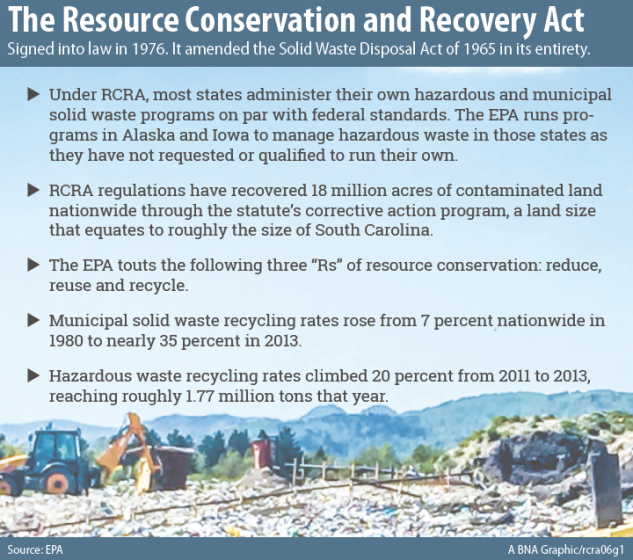
RCRA establishes a framework for the vast majority of states to implement and administer their own management programs for hazardous waste and non-hazardous waste, known as municipal solid waste. State programs must meet federal standards. The regulations also put in place a corrective action program, which requires cleanup of blighted lands.
The EPA runs the hazardous waste programs in Alaska and Iowa.
Keeping Pace With STAG Cuts.
The EPA is the primary source of state RCRA funding through state and tribal assistance grants (STAGs) disbursed annually to the 10 EPA regions nationwide. Regional officials, in turn, dole out those resources to specific delegated state programs.
Total federal RCRA disbursement to the regions dropped over the past half-dozen years, from $103 million in fiscal year 2011 to $99 million in FY 2016, the EPA says.
Meanwhile, the overall congressional STAG appropriation has steadily decreased over the that time period. Congress delivered $3.76 billion in STAG funding to the EPA compared to $3.51 billion in FY 2016.
Many state waste officials told Bloomberg BNA they are struggling to keep pace with the recent decreases in federal funding.
“The bottom line is there has been a reduction in the STAGs generally,” David Livengood, hazardous waste and tanks manager at the Oregon Department of Environmental Quality, told Bloomberg BNA in an interview. “So our overall budget used to come heavily from [state] funds and STAGs and some fees. Over the years, our budget has been reliant on more fees than it ever had before, and less STAGs.”
Federal resources are directed only for hazardous waste management; the EPA leaves states to their own devices in municipal solid waste.
Staff Reductions.
“The funding reductions have caused a reduction in staff; some of that is good and some is challenging,” said Livengood. “We’re trying to find ways to bolster technical assistance as well as compliance and enforcement.”
Marc Roy, section chief at the Vermont Department of Environmental Conservation’s Hazardous Waste Management Program, echoed that view in comments to Bloomberg BNA.
“We have, like pretty much every other state, lost funding over time pretty steadily. Our budget is smaller than it used to be, but we’re meeting our commitments every year,” Roy told Bloomberg BNA, referring to inspections of treatment, storage and disposal facilities. “We have for years now not had enough federal money to cover our programs, so we’ve tapped into other sources of state funding.”
Roy said he’s had to shed a manager and cut down total staff members from eight to six.
Reformulation Shakes Up Allocations.
Just over a year ago, the EPA, drawing partially off a 2007 Association of State and Territorial Solid Waste Management Officials report, reformulated its regional disbursement methodology to reflect the changing landscape of RCRA priorities.
The new methodology, articulated in a March 2015 memo to regional RCRA directors, significantly boosts funding to Region 1, which includes Vermont, and provides a slight increase to Region 10, the Northwest region that includes Oregon.
The reallocation, which phases in from FY 2016 to FY 2020, slashes funding for Region 6, comprised of New Mexico, Texas, Oklahoma Arkansas and Louisiana, by more than 15 percent.
Despite those cuts, Region 6 state officials told Bloomberg BNA they continue to administer their programs effectively.
“We’re decreasing gradually, and we need to continue to evaluate the program,” said Tammie Hynum, chief of the Arkansas Department of Environment Quality’s Hazardous Waste Division, said in an interview with Bloomberg BNA. “Our mission remains the same regardless of the funds. There’s not less on our plate, so we just need to be smarter in our administration. The cut was a decision that was made in D.C. by EPA.”
Hynum said her staff continues to push forward unabated with RCRA recycling, reclamation and waste minimization programs.
A hazardous waste representative from Texas said his staff expects to cope successfully with the reduction.
“The major impacts have not yet hit us,” said Texas Commission on Environmental Quality Communications Director Terry Clawson. “Adjustments will be made as necessary based on the STAG and on future appropriations from the Texas Legislature.”
Lack of Progressive Vision.
Region 6 waste officials declined to comment on RCRA shortcomings and needs for improvement.
“ADEQ does not feel that we have any restrictions in the law that prevents us from working toward completing our mission,” Hynum told Bloomberg BNA.
Representatives from progressive states, however, namely Oregon and Washington, criticized the implementation and funding of the program for failing to encourage a deviation from hazardous materials.
Those states, along with California and Vermont, have put in place some of the most stringent and ambitious recycling and toxic substance overhaul legislation nationwide. Progressive state waste officials point to Vermont’s Universal Recycling law, legislation that requires the complete removal of organic waste from landfills by July 1, 2020, as a key advance.
But from hazardous waste and municipal solid waste perspectives, some waste officials urged the EPA to push RCRA revisions forward that aim to clean up commercial waste management.
Livengood said RCRA could provide a platform to discourage use of highly toxic and carcinogenic materials.
‘Green Chemistry.’
“We have more interest now in changing molecules, and RCRA doesn’t really do that. Some states are heading in the direction of green chemistry, which involves changing processes fundamentally,” Livengood told Bloomberg BNA, noting Washington state’s clean manufacturing initiatives 16 EHSDSN 18, 5/2/16, 40 CRR 506, 5/2/16, See previous story, 05/02/16, 83 DEN B-3, 4/29/16. “We still are in a system that supports the old manufacturing technology of 1940s through the 1960s. We can use the different tools that are available to us and we can make the same things.”
Laurie Davies, waste program manager at the Washington Department of Ecology and a member of the Association of State and Territorial Solid Waste Management Officials board, told Bloomberg BNA that RCRA hasn’t “moved the needle” toward supply chain improvements.
“In the 40 years of RCRA, the law has done a pretty good job at the end of the pike. But we haven’t been as successful at saying ‘let’s not produce those chemicals,’ ” she told Bloomberg BNA. “[Polychlorinated biphenyls], for instance have been banned for 30 years, and now we’re seeing new discharges showing up in yellow dye, sidewalk chalk. Why is that? It’s because we’re not dealing with the chemical that is causing the problem, and we’re not making the strides to prevent hazardous materials as effectively as we should be.”
Reform of the Toxic Substances Control Act could play a critical role in that effort, Davies said. Members of Congress claim to be nearing a TSCA reform agreement 40 CRR 489, 5/2/16, 56 RKPG, 4/29/16, See previous story, 04/29/16, 16 EHSDSN 18, 5/2/16, 83 DEN A-1, 4/29/16.
New Rulemaking Perpetuates Tweaks.
The EPA, however, continues to roll out new RCRA rules to optimize the program.
Among other new regulations, the agency has finalized rules on the definition of solid waste rule, coal ash management and electronic documentation of waste since the outset of 2014.
The electronic documentation rule, referred to as e-Manifest, authorizes electronic manifests to track hazardous waste shipments under RCRA, and the EPA says it could save $75 million and between 300,000 and 700,000 hours of labor tied to carbon copy filing.
“[e-Manifest is] going to bring RCRA into not just the 21st century, but maybe the 20th century,” Stanislaus told Bloomberg BNA with a laugh. “Currently this ‘cradle to grave’ system is literally based on the flow of paper. This is to bring that to an electronic age so we will know the flow and confirm in an electronic way ... to know more readily that the system is working.”
Roy, the Vermont waste chief, said implementation of the rule, slated for 2018, would help compensate for budget cuts.
“If we can e-Manifest and download information, that allows me to free up half or more of a full-time employee,” he told BNA. “Frankly we’d be surprised that if we meet that [2018] deadline, but I can really appreciate, from EPA’s standpoint, the drive to software. Hopefully we get to a point where we can push some buttons and manifest. Some hiccups are probable, but we hope it goes smoothly.”
But the definition of solid waste rule, which would enable a number of frequently generated manufacturing byproducts to qualify for exemptions from hazardous waste regulations under RCRA if they meet certain conditions, has produced more varied reactions.
Steve Simoes, a hazardous waste permitting official under Roy, praised improvements in the final rule vis-a-vis the EPA’s original proposal. Oregon’s Livengood, however, said the final rule didn’t go far enough.
“There’s not enough environment protection assurance in that rule, which is why some states are sitting on their hands,” Livengood told Bloomberg BNA. “If it’s mismanaged, you’re going to have environmental consequences that are not that interesting to Oregonians.”
Environmental and industry groups continue to litigate the rule 76 DEN A-11, 4/20/16, See previous story, 04/20/16, 31 TXLR 379, 4/21/16, 47 ER 1236, 4/22/16.
If the courts sanction its implementation, states will be obligated to adopt, at minimum, a mandatory component.
Permit Modifications.
In the interview with BNA, Stanislaus hammered home the need for states to “nimbly” modify hazardous waste permits under RCRA. Modifications are required when an industrial change takes place at a RCRA facility.
The statute outlines three classes of permits, with the top two categories demanding a far more extensive approval process, including a long list of community outreach obligations.
“While [facilities] have existing permits, they’re going to have to modify their permits roughly about every 18 months for business reasons. As their product [specifications] change, the materials change as well,” Stanislaus said. “A lot of people believe that just because RCRA permits were issued, then government is done. But it’s important to understand that the real driver to both safe management of hazardous materials, as well as enabling the U.S. economy for all these economic outputs, is to nimbly be able to modify these permits on a regular basis.”
Stanislaus emphasized the significance of states retaining budgets and staff levels that meet permit modification demands.
State officials, however, hit back at the suggestion that their modification capacities are lacking.
“Most of our RCRA permit applications are modifications or renewals, which typically include modifications,” said Texas’s Clawson. “We have adequate capability to prioritize and process these applications in a timely manner. Modifications often facilitate more commerce.”
The EPA released a permit modification report in January.
EPA Pushes Recycling Agenda.
Waste recycling is one industrial practice covered under RCRA.
U.S. delegates recently convened with G-7 counterparts to hit home the value of promoting a “circular economy,” the broad notion that countries should deviate from new material reliance in favor of reused and recycled materials.
Stanislaus, in an interview with Bloomberg BNA following that G-7 summit, stressed the importance of that strategy within the broader goal of reducing greenhouse gas emissions 60 ECR, 3/29/16, 61 DEN B-1, 3/30/16, See previous story, 03/31/16, 47 ER 1010, 4/1/16, 2016 GLIN 04, 4/5/16, 39 INER 487, 4/6/16.
The EPA says municipal solid waste recycling rates have dramatically increased over recent decades, but the rate has flat-lined at roughly 34 percent since 2010.
“It seems like we’re stagnant in the roughly mid-30’s range for recycling rates,” Dania Rodriguez, executive director of the Association of State and Territorial Solid Waste Management Officials, told Bloomberg BNA in an interview. “We can improve through more education and dialogue; there are a lot of differences across the regions and states.”
The EPA lacks a mechanism under RCRA or other statute to require states to ramp up recycling, she said.
The U.S. simply cannot perpetuate a culture of raw materials reliance, however, Stanislaus said.
He added: “One half to three quarters of raw materials’ annual inputs to industrial economies are returned to waste to the environment within a year,” he said. “So basically we’re on this, what most people talk about, we’re in a coupled economy at this moment. That means for GDP to grow we have to continue to bring about new raw materials. So we’re at a point that that’s not sustainable.”
“The U.S. alone has consumed 50 percent more materials at the turn of the 21st century than in 1975,” Stanislaus said. “We bury about a billion dollars of commodities every year. There are aluminum cans in landfills in every year.”
Hazardous waste recycling also has dramatically increased in recent years, the EPA says.
“Generally, the most recycled hazardous wastes are typically metals, solvents and acids,” EPA spokeswoman Melissa Harrison told Bloomberg BNA.
In 2013, 1.77 million tons of regulated hazardous wastes were recycled. Of this amount: 61.1 percent, or 1.084 million tons, were metal recycling; 25.7 percent was other recycling such as spent catalysts and acids; and 13.2 percent was solvent recycling, Harrison said.
This 2013 amount of hazardous waste recycled represents an increase of 29,435 tons or a 20 percent increase in hazardous waste recycled compared to 2011, she said.
‘A Lot of Good Work.’
The program continues to evolve and adapt, but RCRA has delivered positive results to the country, said Arkansas’s Hynum.
“Functionality has been good,” she said. “We’ve had opportunities to apply lessons learned, and that is evident in the proposed rulemaking. I look forward to another 40 years of RCRA.”
Rodriguez painted a similarly optimistic picture.
“I think it’s one of those wonderful programs that does so much good,” she said. “As it turns 40 this year, we are all looking to improve, but a lot of work has been done. RCRA is a mature program that works collectively with industry. People realize a lot of good work has been done.”
To contact the reporter on this story: Brian Dabbs in Washington at bdabbs@bna.com
To contact the editor responsible for this story: Larry Pearl at lpearl@bna.com
Learn more about Bloomberg Law or Log In to keep reading:
See Breaking News in Context
Bloomberg Law provides trusted coverage of current events enhanced with legal analysis.
Already a subscriber?
Log in to keep reading or access research tools and resources.