


Approximately 2 percent of the U.S. is covered by impervious surfaces—rooftops, roadways, driveways, parking lots. While this is a relatively small percentage of land cover, the impact of these surfaces on waterways reaches far beyond this proportion, especially in highly urbanized areas where impervious cover rates can reach 50 percent to 75 percent or higher. Post-construction stormwater runoff was only first regulated in 1990 when the Environmental Protection Agency issued its Phase I Municipal Separate Storm Sewer System (MS4) permit program. This regulation officially categorized urban stormwater runoff as a “point source” discharge within the National Pollutant Discharge Elimination Program (NPDES). Previously, the permit program had been reserved for discharges from sources such as wastewater treatment plants and other industrial facilities. Initially, about 750 communities were subject to the MS4 program and were required to develop plans detailing how they would address the impacts from urban stormwater discharges. EPA revised the rule for the NPDES Phase II permit in 1999 to include small, municipal, separate storm sewer systems (those serving fewer than 100,000 persons) and construction sites that disturb one to five acres, which expanded its coverage from 750 to 7,500 cities and communities.
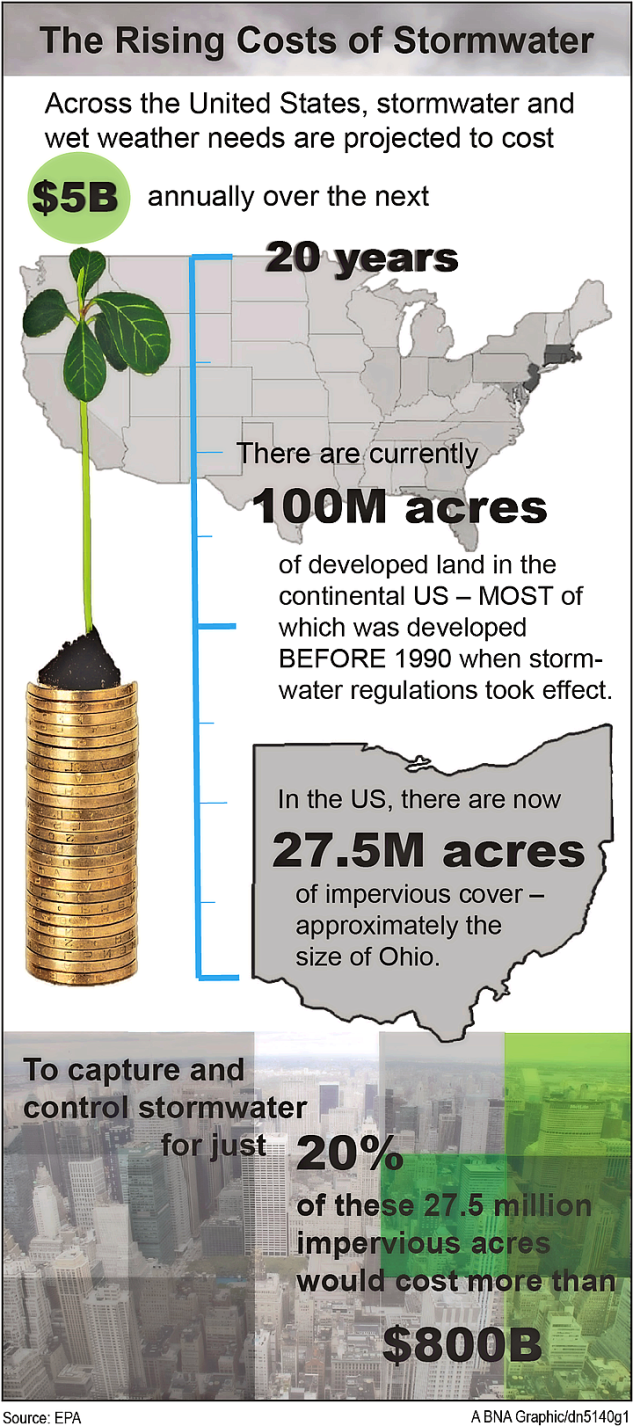
Explosion of Urbanization.
Between 1910 and 1990, the population of the U.S. increased by over 250 percent, resulting in an explosion of urbanization. However, little stormwater management was provided to mitigate the effects of increased impervious cover on the landscape other than regional efforts to reduce flooding impacts with no significant focus on protecting the ecological health, physical stability and overall quality of stream, lakes and coastal waters. In fact, everything in the built environment was designed and constructed on a slope to quickly move water away, thereby increasing the amount of stormwater runoff to nearby receiving waters.
With more impervious land development and less permeable surface area to support recharge of our groundwater supplies, we’ve not only altered surface hydrology by increasing peak runoff flows, but we’ve severely changed subsurface hydrology. These impervious areas continue to deliver pollutants and flashy flows to downstream waters, consequently degrading headwater streams due to excessive channel erosion. Flashy flows have higher peaks than in a natural, pristine setting that peak and drop quickly. They are also associated with an increase in erosive flows in receiving streams.
Climate change has already increased flooding impacts in areas that lie within as well as beyond federally recognized floodplain zones. Due to the ongoing nature of this increased flooding and other runoff impacts, the stormwater management sector is turning towards urban retrofits to begin reversing the effects of urbanization on waters, while looking for better ways to sustainably manage rain water – sometimes referred to as green infrastructure (GI) or green stormwater infrastructure (GSI).
Integrated GI or GSI in urban retrofit programs is increasingly being used to address stormwater and wet weather challenges across the country. However, due to the relatively high cost of these practices—resulting largely from government procurement systems that have primarily been established to fund, design and construct larger and fewer grey centralized facilities versus hundreds, if not thousands, of small green decentralized installations—GSI has not realized its potential, especially as it pertains to watershedwide implementation.
High Cost of Retrofits.
Urban stormwater retrofit costs range from $50,000 to $300,000 or higher per impervious acre treated. However, the costs for urban retrofits are already being consistently driven down through the use of the CBP3 approach. Using an average value of $150,000 per impervious acre treated, it would cost over $800 billion to implement a 20 percent retrofit for the 27.5 million acres of impervious cover across the country. The cost for this level of retrofitting impervious areas currently is projected at over $1 billion for some urbanized communities in the Mid-Atlantic region.
With the U.S. facing multiple economic challenges, such as growing healthcare costs and a growing federal debt, the funding gap associated with addressing our aging infrastructure is likely to grow if we choose to rely mostly on public dollars for infrastructure investments. We must find methods to lower the cost and increase the rate of implementing integrated green infrastructure in order to address the significant and growing impacts from stormwater runoff. With GSI practices as the focus of these investments, communities could realize benefits beyond improved water quality. Other benefits include enhanced quality of life and public health, more resilient cities, small business development and more entry-level jobs (some of which will be “green jobs” while others will be traditional jobs, such as construction and other service-related industries, and economic growth/revitalization).
Examples & Drivers of Green Stormwater Infrastructure
The term “green stormwater infrastructure” refers to practices that focus on reducing the volume of runoff generated from a site through either rainwater harvesting or infiltration-based methods. Examples include:
- Downspout disconnection
- Rainwater harvesting
- Rain gardens (bioretention)
- High-flow bioretention
- Planter boxes
- Bioswales
- Permeable pavements
- Green roofs
Multiple drivers exist for GSI implementation depending upon the type of clean water infrastructure requirement addressed, local water quality and quantity conditions and regional issues. For instance, combined sewer systems, which convey both surface drainage and sanitary flows, often become surcharged during storm events leading to combined sewer overflows or CSOs. Many cities, especially those in the Mid-Atlantic, Northeast and Midwest, utilize these systems and have permit requirements implemented through long-term control plans (LTCPs) to reduce the volume and frequency of these CSO events to meet NDPES program requirements. This need to reduce or control excessive runoff has led some of these cities to build large underground holding systems that attenuate peak flows and reduce CSO events.
However, more recently communities are choosing to include GSI due to financial and multiple co-benefits. These include improved air quality, improved resilience, water conservation, lower utility bills, increased property values, more diverse jobs and local employment, economic revitalization and reduced urban heat-island effects, as well as the cost-competitiveness of this alternative in many circumstances. MS4s, which are stormwater conveyance and treatment systems in urban areas, do not include sanitary flows and are also governed by the NPDES program. However, the challenge for MS4s is to control stormwater pollution and reduce runoff before these flows enter the conveyance systems that discharge them to downstream waters.
TMDLs as Regulatory Drivers.
Regionally and locally, regulatory drivers may be governed by total maximum daily loads (TMDLs), which assign pollutant discharge limits for regulated entities and communities in order for receiving waters to attain the water quality standards consistent with that waterbody’s designated use. For example, in the Chesapeake Bay, a regional, multi-state TMDL has been established to address sediment and nutrients that have adversely impacted the health of the Chesapeake Bay. This TMDL’s implementation schedule is aggressive—communities are to address targeted pollutant loadings completely by 2025, which includes urban stormwater runoff. Maryland has chosen to require a 20 percent retrofit of existing impervious areas for Phase I MS4 communities as a key aspect of the state’s Watershed Implementation Plan (WIP) in an effort to address stormwater pollution. The collective costs of this retrofit for Maryland Phase I communities has been estimated to be multiple billions of dollars. This has created the demand for some Maryland communities to seek innovative ways to address large-scale urban retrofits at a reduced cost and at an accelerated rate.
To assist these and other Mid-Atlantic communities, EPA Region 3 has collaborated with a variety of experts and community practitioners to develop an affordable approach and financing platform focused on local economic revitalization, accelerated delivery and long-term operation and maintenance by partnering public and private investments and capacity. Referred to as a Community-Based Public-Private Partnership (CBP3) framework, it has also been developed to create a more effective and efficient procurement and management system for large-scale green infrastructure implementation. This approach is already illustrating the capacity for local governments to save as much as 40 percent to 60 percent when compared to that of traditional GI procurement.
The publication, “Community Based Public-Private Partnerships (CBP3s) and Alternative Market-Based Tools for Integrated Green Stormwater Infrastructure: A Guide for Local Governments,” outlines this approach to provide information to local governments as well as financing professionals, public-private partnership (P3) experts, stormwater practitioners, regulators, and decision-makers.
Traditional Public-Private Partnerships in U.S.
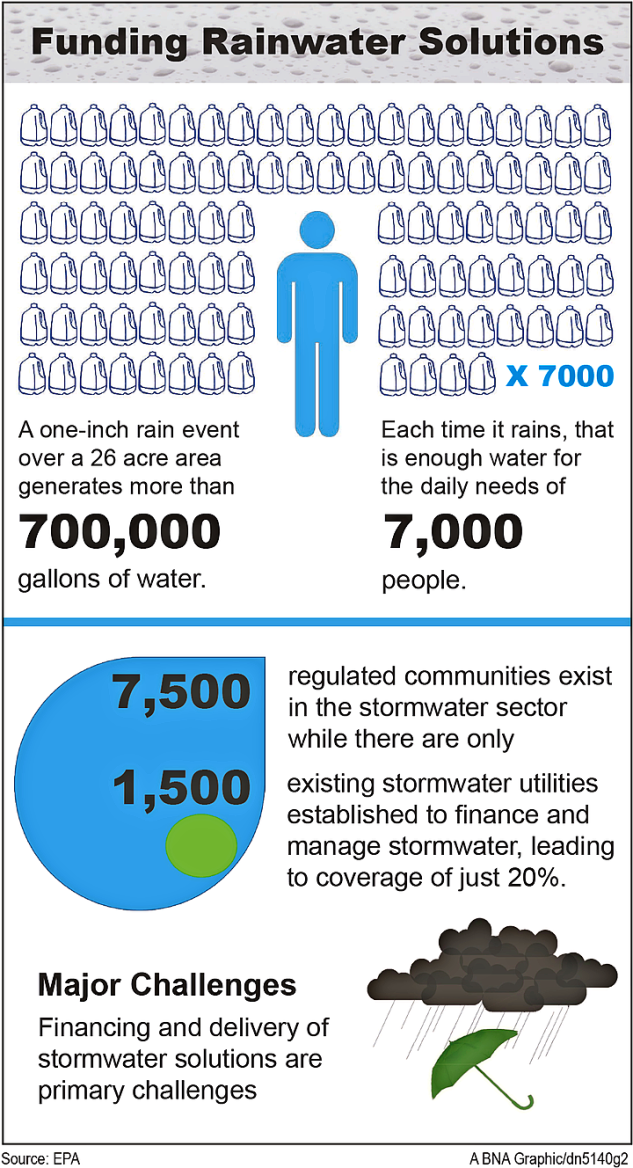
Public-private partnerships have been used in a variety of sectors in the U.S., most notably transportation. They can come in various forms and range from design-build to design-build-finance-operate-maintain. As noted in the guide:
P3s differ from conventional procurements where the public sponsor controls each phase of the infrastructure development process—design, construction, finance, and O&M. In the P3 approach, a single private entity or a consortium of private entities assumes responsibility for more than one of these development phases.
Benefits of using a P3 approach to address stormwater infrastructure needs for local government, as noted in the guide, include:
- Allocating responsibilities to the party that is best positioned to control the activity is more likely to produce a desired result.
- Producing economic value through private sector participation; injecting business ingenuity, energy, efficiencies, and capital into infrastructure; and applying a “funding multiplier” to leverage local government investment.
- Solving a complex, costly public problem critical to watershed protection with more efficient and cost effective outcomes compared to conventional programs and procurement methods.
- Substituting private resources and personnel for constrained public resources.
The particular structure of a P3 depends upon state statutes and the limits of autonomy for local jurisdictions. Currently, 33 states and the District of Columbia have some form of enabling legislation for P3s, which provides guidance on aspects of P3 frameworks such as these listed from the guide:
- Procurement processes and methods;
- Agreement provisions;
- Review and approval processes for proposed P3 arrangements;
- Project eligibility;
- Use of private consultants;
- Length of concession;
- Bid selection, and
- Authority to enter into P3 arrangements.
While many states’ enabling legislation is limited to transportation infrastructure, there has been an increase in the diversity of projects included in P3 legislation, including those addressing stormwater. For example, stormwater projects were incorporated into P3 legislation approved in the District of Columbia, and similar language has recently been proposed in Pennsylvania as well.
Overview of the Community Based Public-Private Partnership (CBP3) Approach
The CBP3 approach was specifically developed to better accommodate affordable, large-scale, multi-beneficial GI implementation and operation and maintenance.
According to the guide:
A CBP3 program uses many of the same financial and procurement arrangements as a traditional P3; however, there are differences as well. The long-term nature of the contract, the wide-range of retrofit opportunities, the flux in economic and community development conditions over time, and the need for flexibility are the key differences between a CBP3 and a typical infrastructure P3.
In a CBP3, the conditions must be appropriate for the community and the contractor so that both receive equitable benefits for all actions and that both partners gain from the efficiencies and reduced costs of adaptive management and advances in technology. Because of the need to negotiate multiple subcontract agreements, evaluate and make rapid implementation decisions, and coordinate with multiple stakeholders, the community must have a significant amount of trust that the contractor will act as an agent for the community throughout the long-term partnership.
This model to address integrated green infrastructure investments is rooted in a Department of Defense program referred to as the Residential Communities Initiative (RCI) that was started in the mid 1990’s to address the quality and capacity of military housing.
An important element of the RCI program has been the use of long-term, low-risk incoming revenues (i.e., military housing stipends) to gain highly favorable interest rates from the private investment community (Ellis, 2009). Economies of scale along with innovative construction practices effectively drove down costs while meeting the desires of military families to a much higher degree than past programs.
Another hallmark of the RCI has been the investment made in the community served. An example of this investment is the use of surveys by PMHI to identify the aspects of military housing of greatest need and interest. This helped make the most meaningful investments possible in terms of well-being and satisfaction. Use of on-going surveys ensures that systems are maintained properly and provide feedback to improve future investments in housing.
CBP3s—similar to traditional P3s—can be established through a limited liability corporation (LLC) that includes both public and private sector professionals. However, a CBP3 agreement can also be established through a performance-based service contract—as indicated in the guide.
The purpose of the LLC is to oversee the CBP3 program, which includes identifying service providers from the design, permitting, administrative, legal, construction and operations and maintenance sectors to the implementation of green infrastructure investments. Additionally, the LLC must coordinate the financing package in a manner that best serves the partnership goals and objectives.
Status-Quo Approach Inefficient.
The status-quo approach to implementing stormwater infrastructure is in a piecemeal, project-by-project fashion. This manner of implementation is riddled with inefficiencies, as each project requires separate transaction efforts, including permitting, procurement of services, and design efforts. Projects addressed in a vacuum utilize limited quantities of materials and construction mobilization costs, which does little to reduce costs.
According to the guide:
The CBP3 model for GI stormwater retrofits has a number of distinct benefits and advantages when compared to traditional infrastructure financing structures, including opportunities for:
- Economies of scale in the provision of critical services or activities;
- To promote, develop, and reflect advances in reporting, verification, and cost effectiveness; and
- For mutual learning and implementation between partners on procurement, job development, management, outreach, and reporting activities.
Rather than implement GI through a project-driven approach, the vision of the CBP3 framework is to focus on holistic programmatic outcomes—for example a jurisdiction’s stormwater restoration plan. For instance, rather than attempt to identify projects that encompass 2,000 acres of impervious cover to retrofit, the CBP3 approach is to set the goal of retrofitting 2,000 acres and allow the CBP3 to leverage the large-scale volume of this goal to reduce costs as well as identify the most cost-effective means to meet the desired outcome. Similarly, procurement following this framework does not require multiple bids per project, but rather allows the partnership to work with service providers who can deliver their services across an entire program, which drives down costs further. As previously noted, costs associated with CBP3 programs are already seeing reductions in urban retrofit implementation costs. The Clean Water Partnership, the CBP3 established by Corvias Solutions to meet the needs of Prince George’s County, Md., is already realizing urban retrofit costs between $40,000 to $60,000 per impervious acre treated—a significant reduction compared to traditional costs. The work done by the LLC does not preclude the public sector’s involvement in GI implementation. To the contrary, the public sector will be freed up to pursue high-profile or more challenging projects that may be of political or social significance.
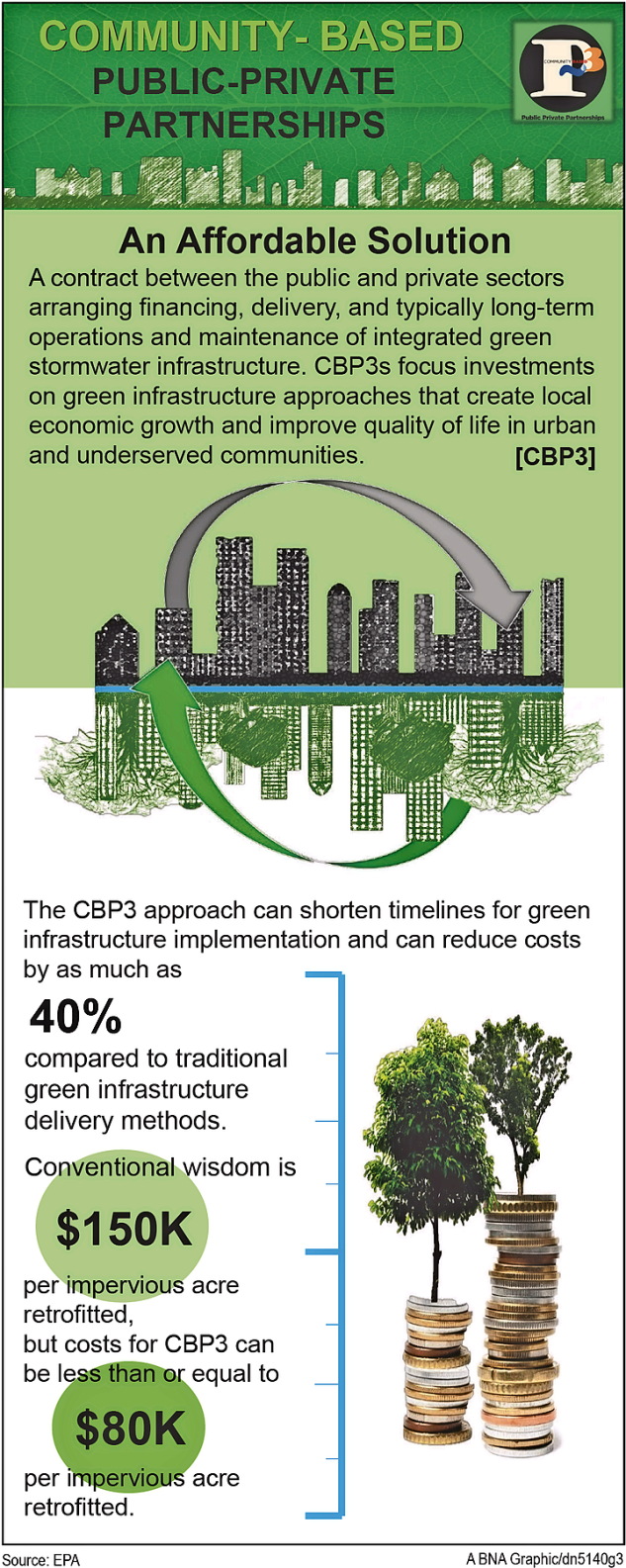
Financial, Programmatic and Social Benefits of CBP3s
The basis of the CBP3 approach is the focus on partnership. Unlike many traditional P3 projects, the CBP3 approach seeks to maximize the social and environmental benefits while reducing the unit cost of GI retrofits. This is accomplished through the unique nature of the CBP3 structure. The use of capital stacking, which is the leveraging of low-cost public financing to reduce private capital, can help to drive down the cost of money. Additionally, the use of dedicated funds, such as a stormwater fee, provides further leveraging potential. Beyond reducing costs, social benefits of CBP3s for GI implementation are significant.
The guide discusses how CBP3s can address local jobs, social well-being and public health:
The role of community is central to the CBP3 approach, as exemplified by its name. From economic revitalization to local jobs creation, to enhanced social well-being, the community benefits of this framework, designed to accelerate large-scale implementation of GI are clear. Unlike other forms of infrastructure, such as that of a toll road or a power plant, green infrastructure is also intimately tied to the social aspects of a community. A GI practice or system may be an amenity used in a community to recreate, for instance. Additionally, numerous studies show that social well-being increase for urban dwellers located near vegetated or otherwise “green” infrastructure, such as parks, street trees or vegetative practices.
Another significant social benefit is public health enhancements, such as reduced occurrence of asthma rates for children as well as a reduction in heat-related deaths in peak summer months in urban area. Moreover, stormwater management practices built around natural hydrologic functions and increased use of vegetation can dramatically reduce energy consumption. Green roofs, street trees, and increased urban green spaces have the effect of making individual buildings more energy efficient by reducing heating and cooling demands. On a neighborhood or community level, the shading and insulation provided by these techniques cools urban heat islands, again reducing the energy required to cool indoor spaces during summer months. Additionally, by re-using harvested rainwater, some green infrastructure approachesdecrease the need to use potable water for landscaping, toilet flushing, or other industrial uses. In turn, this reduces municipal and utility expenditures to transport, treat, and deliver potable water.
However, the dimension of “community” goes beyond these types of benefits to local residents, as it also includes commercial and business health and sustainability that, in turn, helps to create more local jobs. A hallmark of the CBP3 approach is the long-term commitment between the public and private partners, as well as the partnership’s relationship with community stakeholders, such as religious and educational institutions and non-profit groups, such as watershed-related stakeholder groups. This long-term commitment allows the private partner to cultivate and develop local businesses and industries supporting the GI sector through stewardship and economic development of small and disadvantaged businesses, for example. Work anticipated within a GI-driven CBP3 framework that helps to ensure compliance with Clean Water laws, includes not only design and construction skills, but operations and maintenance (O&M), as well. The focus on O&M in stormwater programs has historically been lacking; however, as more research is done in this area, it is evident that maintenance is necessary for the overall health of GI practices and systems, and ensures for successful performance. The O&M service sector is also uniquely suited to match up with disadvantaged communities who may have access to the local available labor force. As a GI-driven CBP3 program matures, the effect of greened streets and parking lots will help to enhance property values through hedonic effects. Regression analyses performed on real estate sales have shown that the increase in land values for properties adjacent to open space more than offsets the property tax revenue loss associated with acquiring open space for preservation.
The guide also provides an overview and examples of market-based tools to drive and accelerate more affordable and effective innovative GI retrofits. These approaches can support a variety of integrated GI water and other infrastructure needs.
Role of Market-Based Frameworks in CBP3 Approach
While the CBP3 approach has great potential to reduce costs and increase the pace of GI implementation, other non-traditional methods of cost-saving GI implementation are available. The District of Columbia’s Stormwater Retention Credit (SRC) trading program has been established to harness market forces that allow owners of high-cost stormwater treatment projects to reduce costs by purchasing a portion of their treatment requirements from owners of low-cost projects. Another method of utilizing market-based forces to reduce costs for GI retrofits is cost-based grants, which is the basis of the approach taken by the Philadelphia Water Department (PWD). Some communities believe the unit cost of GI retrofits in urban areas can reach $250,000 to $300,000 or more per impervious acre treated; however, Philadelphia believes there are projects that can deliver retention-based projects at a cost of $90,000 to $100,000 per acre treated. These unit costs can be attained by aggregated projects to gain efficiencies of scale and reduce transaction costs.
These market-based forces alone can help to reduce costs of retrofits; however, when nesting these approaches within a CBP3 program even greater cost saving potentials can be realized. The guide explains this synergistic relationship:
In a CBP3 context, one can envision the organic development of “turn-key” provider private entities who provide an array of implementation services, including project identification/siting, performing feasibility analyses on identified sites (for financial viability), full site/project design, project management, construction, and inspection and maintenance services. Multiple “turn-keys” could be unleashed by the CBP3 to operationalize the effort to implement GI widely.
For example, a trading program may employ a limited number of approved standard GI practices that can be used to generate credits. These credits could be purchased by the CBP3 entity, and having multiple providers would generate cost-reducing competition to the benefit of the CBP3 entity (and the municipality). It is anticipated that turn-keys would represent profit-maximizing entities who employ top-level specialists in GI implementation who could most efficiently scan the landscape for scenarios providing the lowest-cost opportunity for GI implementation. Some turn-keys could potentially specialize in land use types/scenarios to further increase efficiency. For instance, one turn-key may focus retrofitting of large commercial strip malls or church parking lots, while another turn-key may deal only with large institutional or industrial sites. This specialization could allow turn-keys to become familiar with specific land use types in order to lead to cost-optimized/maximized “harvesting” of stormwater credits on sites.
In an incentivized grant program, such as the Philadelphia Water Department (PWD) program, the CBP3 entity could set cost thresholds for projects they would invest in. As with the credit trading approach, multiple “aggregators” could work to identify the best grouping of sites that would meet, or exceed, the cost threshold set by the CBP3 entity. Also, specialization of GI implementation in this context could occur if the CBP3 potentially set varying cost thresholds that could vary by land use type or scenario, thus recognizing the cost variability associated with GI in different contexts. This could help to ensure that a mix of land use types/scenarios, including blighted, low income neighborhoods, experience “greening”, rather than just the “low-hanging fruit” scenarios. As with the Prince George’s County CBP3, it could also ensure for local small business development and job training to employ residents.
Conclusion
The U.S. has a significant infrastructure funding gap that is likely to grow over time if innovative investment methods are not developed and employed to address these needs. According to the American Society of Civil Engineers, the costs to fix deteriorated infrastructure in the U.S. are projected to be nearly $3 trillion between 2013 and 2020, and the country is currently short by over a trillion dollars. There are regions that already are experiencing significant funding pressure, such as that of the Chesapeake Bay watershed where the estimated costs for Chesapeake Bay watershed communities to meet regulatory requirements related to urban stormwater runoff management are projected to be several billion dollars per year over the next 10 years. Large public funding programs for Clean Water infrastructure investments cannot finance current and future infrastructure needs—nor can any and all governments—alone. Private equity investors have a proven interest in infrastructure projects. Unique and innovative designs, technologies, funding, financing and delivery approaches are being developed to challenge the status quo method of stormwater infrastructure implementation. The U.S. is experiencing a significant growth in P3 projects, which are increasingly becoming more diverse, as demonstrated by that of integrated, green infrastructure investments. The Community-Based P3 program approach, which is tailored for green infrastructure, has been developed and is starting to be considered by more local jurisdictions. Local governments can benefit from learning more about the details of this approach, and EPA is developing resources to help communities better understand if and how a CBP3, along with market incentive tools, may be an appropriate way to meet regulatory requirements associated with stormwater pollution, while achieving local economic growth and other benefits.
Learn more about Bloomberg Law or Log In to keep reading:
See Breaking News in Context
Bloomberg Law provides trusted coverage of current events enhanced with legal analysis.
Already a subscriber?
Log in to keep reading or access research tools and resources.