


As with many water projects in the West, the fate of a planned 300-mile pipeline through the Nevada desert to Las Vegas likely will be resolved in court, and environmental plaintiffs are prepared to fight it in both state and federal arenas.
Litigation is pending in a state court in Ely, Nev., as environmental groups have challenged the state’s approval in March of water allocations from the aquifers sitting beneath the desert floor in four valleys north of Las Vegas.
The main argument by plaintiffs is that State Engineer Jason King failed to make valid estimates of the project’s impacts on other water users and the environment as groundwater levels are drawn down. According to opponents of the project, the state engineer erred by approving large-scale withdrawals that will exceed the aquifer recharge rate, making the plan unsustainable, threatening the water rights of other citizens, and threatening populations of plants and animals.
The opponents include affected counties, environmental groups such as the Sierra Club and Center for Biological Diversity, Native American tribes, the Nevada Farm Bureau, and private citizens.
The Southern Nevada Water Authority, in proposing the project, and the state engineer in approving it fudged their estimates to justify the plan, in the view of Simeon Herskovits, an attorney representing environmental groups and the counties. In discussing the issue with BNA, he said the legal arguments against such a project would be similar in many other Western states because of similarities in state water laws.
The Las Vegas metropolitan area, with a population of nearly 2 million, depends on the Colorado River for at least 90 percent of its water, and many in the area are uncomfortable with that level of dependence, especially after more than a decade dominated by regional drought.
Nevada Looks to Diversify.
To address the situation, the Southern Nevada Water Authority (SNWA) has been trying for years to diversify its water sources through a groundwater development project that would tap aquifers beneath the arid lands of east-central Nevada.
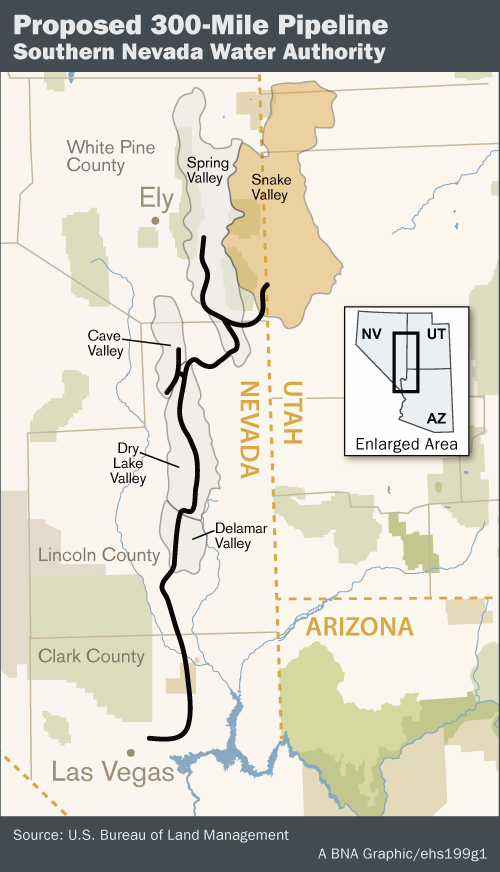
The proposed project involves building a 300-mile underground water pipeline to transport water through White Pine, Lincoln, and Clark counties to the Las Vegas area, which is in Clark County in the southern tip of the state. The multibillion dollar project would include five pumping stations, six regulating tanks, three pressure-reducing stations, a buried reservoir, a water treatment facility, and seven electrical substations.
The groundwater would be moved southward from at least four valleys—Spring Valley, Cave Valley, Dry Lake Valley, and Delamar Valley. The Snake Valley, a fifth area that straddles the Nevada-Utah border, may be added in the future if overlapping state water rights can be resolved.
In March 2011, SNWA—which includes water agencies for Las Vegas and the suburbs of Henderson, Boulder City, and North Las Vegas—prepared a Conceptual Plan of Development for the federal Bureau of Land Management, which needed to approve rights of way for the project. Most of the state’s 2.7 million residents are concentrated in the SNWA’s area of jurisdiction, while the counties with the groundwater are sparsely populated.
Concern About Lowering Water Tables.
Many are more uncomfortable, however, with the water development plan than with continued reliance on the Colorado River. Tapping the aquifers creates the possibility of lowering water tables so much that scarce surface waters in springs and ponds could dry up, killing fish, other animals, and plants.
SNWA still has several more years of slogging through environmental studies, infrastructure planning, and litigation before it can construct the underground pipeline. Litigation has delayed the plan in the past, and more litigation in state and federal courts is under way, as environmental activists, ranchers, farmers, sportsmen, local governments, and native Americans attempt to block or scale back the project.
Environmental advocates also have argued that southern Nevada should increase conservation and recycling rather than pursuing the pipeline project. They have said Nevada should consider negotiating a larger share of Colorado River water by offering to finance desalination projects for California as a step to reduce California’s share of the river’s flows.
Pipeline May Depend on Colorado Conditions.
The water now sustaining Las Vegas is drawn almost entirely from Lake Mead, held in place on the Colorado River by Hoover Dam. For now, that is enough.
“The actual onset of pipeline construction is going to be dependent on the actual conditions on the Colorado River,” J.C. Davis, a spokesman for SNWA, told BNA.
The appropriation of Colorado River water is governed by a multistate compact in which Arizona, California, Colorado, Nevada, New Mexico, Utah, and Wyoming participate. State plans for coping with drought use the water level in Lake Mead as a trigger for conservation. Lately, the level is nowhere near the point of triggering an initial shortage declaration, which in itself is not considered a great hardship. But the farther the water falls, the greater the challenges for states to cope.
Davis said SNWA has enough experience with fluctuations of the river that there is no rush to get the pipeline built. About four to five years will be needed for studies and determination of well locations, after which two to three years would be needed for construction, he said.
The project would cost an estimated $3 billion if built now, although costs would increase over time because of inflation and interest payments. SNWA estimates the cost could amount to $7 billion if construction were spread out over many years and not paid off until the 2030s. If the work were stretched out even longer, with a final payment not until the 2070s, the cost might reach $15 billion, a cautious upper-end, just-in-case estimate, Davis said.
The cost of the pipeline would be borne by SNWA ratepayers, and the high-end estimate has served as another point of criticism for the project’s opponents.
State Gives Approval With Strings Attached.
The most important step at the state level occurred March 22 when King, the state engineer who has authority to administer state water rights, issued a decision that agreed with SNWA on the advisability of diversifying water supplies, although he did not give the agency everything it asked.
The Colorado River “is over-appropriated, highly susceptible to drought and shortage, and almost certain to provide significantly less water to Southern Nevada in the future,” King wrote in the March 22 decision.
In four rulings—one each for the Spring Valley, Cave Valley, Dry Lake Valley, and Delamar Valley watersheds—King approved a total water withdrawal of as much as 84,000 acre-feet annually, or about 27 billion gallons. An acre-foot is 326,000 gallons, much more than a typical household consumes in a year.
King left unresolved the SNWA’s request for Snake Valley water because of the interstate dispute with Utah over rights to the water there.
In his rulings, King required two years of biological and hydrological data collection, a groundwater flow model, and a monitoring, mitigation, and management program for each watershed. He said SNWA would be required to take any and all measures, including curtailment of pumping, if the pumping is found to be detrimental to the public interest or the environment or is having unanticipated impacts on existing water rights and wells.
Federal Approval With More Strings.
The most important step at the federal level was the BLM review of a right-of-way application, because much of the project would be on federal land. BLM had no authority over the water rights but was obligated to consider potential environmental and human health impacts.
On Aug. 3, BLM issued its final environmental impact statement (EIS) for the project that essentially approved the SNWA plan by listing an acceptable alternative in terms of environmental and health effects.
The preferred alternative, like the state engineer’s four rulings, avoided the Nevada-Utah water rights dispute by leaving the cross-border Snake Valley out of the plan. It remains possible that Nevada will ask the U.S. Supreme Court to settle the water rights of Snake Valley.
BLM and SNWA have agreed that the water authority will provide hydrological and biological monitoring to detect potential impacts on springs, ponds, other habitat, and the wildlife populations in the watersheds.
If BLM determines that warning thresholds have been reached as a result of groundwater withdrawals, SNWA will be required to implement adaptive management measures. The measures can include reduced use or shutdown of wells, geographic redistribution of groundwater withdrawals, acquisition of water rights or property to be dedicated to recovery of species, and other measures.
BLM accepted submissions of additional information on the final EIS until Oct. 1, after which a record of decision will be issued.
Fearing Impacts of Water Drawdown.
After reading the final EIS, the National Parks Conservation Association and the Coalition of National Park Service Retirees issued a joint statement expressing their concerns.
“The threats of this water mining project are far reaching: It could be built at anguishing public expense, could dry up the area and plunder Great Basin National Park, threaten the region’s rural life, and create health issues that would multiply economic and social losses,” the two advocacy groups said. The national park is about 300 miles north of Las Vegas near the Utah border.
The Center for Biological Diversity said the project will drive declines in species, especially species associated with “the springs and wetlands that will dry up as the water beneath them is sucked away.”
Hundreds of groups and individuals went to court to challenge the state engineer’s decision in March.
Concerns Taken to State Court.
Herskovits, the attorney with Advocates for Community and Environment, is the lead counsel for environmental activists and local governments that have filed four petitions for judicial review of the state engineer’s rulings (White Pine County v. King, Nev. Dist. Ct., No. CV—6-8119, 4/21/12).
The petitions were filed in the Nevada District Court for the Seventh Judicial District. Not only have diverse interests joined in those petitions, but others have filed parallel petitions. Herskovits told BNA he expects the many petitions to be consolidated and play out in the courthouse in Ely, the county seat of White Pine County.
The main argument is that King departed from sound water law and policy by approving withdrawals at volumes exceeding the aquifer recharge rate, Herskovits said. The approved withdrawal rates will not allow for sustainable availability of water from the aquifers for other holders of water rights and for the government’s responsibility to provide water for plants and animals, he said.
Because water tables need to be maintained for those other purposes, the groundwater in those watersheds should be considered to be already fully appropriated and accounted for, he argued.
Federal Courts, Other Avenues.
The BLM’s final EIS is a likely target of lawsuits in federal court.
“We’ll probably be litigating that in the near future,” Rob Mrowka of the Center for Biological Diversity told BNA.
The EIS might be challenged under the National Environmental Policy Act on a charge of insufficient analysis, “but that’s something we really haven’t fully put together yet,” Mrowka said.
The center filed a lawsuit Sept. 13 in U.S. District Court for the District of Columbia charging the U.S. Fish and Wildlife Service with failing to act on the group’s petition to have four springsnail species listed as threatened or endangered under the Endangered Species Act.
The snails, dependent on Nevada springs, are threatened by SNWA’s proposed “water grab,” the group said in announcing the litigation (Center for Biological Diversity v. Salazar, D.D.C., No. 1:12-cv-1514, 9/13/12).
Mrowka said opponents of the pipeline project also hope to accumulate allies through lobbying the Clark County Commission and city officials in southern Nevada and through appeals to Gov. Brian Sandoval (R).
Learn more about Bloomberg Law or Log In to keep reading:
See Breaking News in Context
Bloomberg Law provides trusted coverage of current events enhanced with legal analysis.
Already a subscriber?
Log in to keep reading or access research tools and resources.